

Board Performance · 2025
In this section14 topics
- Prevention of Conflicts of Interest3 items
- Prevention of the Use of Inside Information3 items
- Anti-Corruption5 items
- Whistleblowing3 items
- Selection of Directors & Chief Executives5 items
- Selection of Independent Directors2 items
- Director Development2 items
- Evaluation of Board & Subcommittee Performance3 items
- Subcommittees1 item
- Meeting Attendance & Remuneration3 items
- Supervision of Subsidiaries & Associated Companies4 items
- Board Duty Performance — Overview1 item
- Audit Committee Duty Performance1 item
- Executive Committee Duty Performance1 item
Prevention of Conflicts of Interest
Has the Company Acted to Prevent Conflicts of Interest?
Yes
Operations in the Past Year
The Company has established policy and guidelines and communicated regarding the prevention of conflicts of interest to our personnel (directors, executives and employees) to be aware of and must strictly comply with a policy and guidelines as well as providing knowledge continuously. The Company has monitored and followed up the implementation to prevent conflicts of interest policy. The directors and executives of the Company must prepare a report on declaration of interests of directors and executives and submitted to the Company Secretary Department for reporting their interests to the Chairman of the Board and the Chairman of the Audit Committee. In addition, the Company has sufficient information to comply with the regulations regarding to the connected transactions. It may cause a conflict of interest and may lead to a transfer of benefits. In 2025, the Company has not received any accusations/fines from the regulators regarding the disclosure of connected transactions or asset acquisitions or disposition and no offenses related to the prevention of conflicts of interest.
The company has a policy to publicize and communicate its policies to all personnel across the organization, achieving 100% awareness. The individuals who are informed include:
Board of Directors: A total of 10 members.
Employees and Executives: A total of 366 individuals, including senior executives and operational staff.
Additionally, the company strictly monitors compliance by requiring all directors and executives to prepare a report on their interests and submit it to the Corporate Secretary. This measure is implemented to prevent potential conflicts of interest that may arise.
Number of Conflict-of-Interest Cases
| Metric | Current Year | Previous Year | Two Years Ago |
|---|---|---|---|
| Total number of cases or issues related to conflicts of interest (cases) | 0 | 0 | 0 |
Prevention of the Use of Inside Information
Has the Company Acted to Prevent the Use of Inside Information?
Yes
Operations in the Past Year
The Board of Directors recognizes the importance of good corporate governance and has established policies and practices to prevent the misuse of non-public insider information for personal gain. The key measures include:
The company has developed written policies and communicated them to employees, executives, and directors, requiring strict compliance.
(Board of Directors: A total of 10 members and Employees and Executives: A total of 366 individuals, 100%)
Directors and executives (including their spouses and minor children) are required to report their securities holdings to the Securities and Exchange Commission (SEC) under Section 59 of the Securities and Exchange Act. Reports must be submitted through the Corporate Secretary within 30 days of assuming their position or within 3 business days of any changes.
Directors and executives must notify the Corporate Secretary of their intention to trade securities at least 1 day in advance of the actual transaction.
Number of Inside-Information Cases
| Metric | Current Year | Previous Year | Two Years Ago |
|---|---|---|---|
| Total number of cases or issues related to the use of inside information to seek benefits (cases) | 0 | 0 | 0 |
Anti-Corruption
Has the Company Acted on Anti-Corruption?
Yes
Operations in the Past Year
The company is committed to conducting its business with integrity, adhering to its responsibility to society and all stakeholders in accordance with the principles of good corporate governance and the company’s business ethics. This includes policies and practices for engaging with various stakeholder groups to develop the organization into a Sustainable Organization. To demonstrate its commitment to combating all forms of corruption and bribery, the Board of Directors has established a written “Anti-Corruption and Anti-Bribery Policy” as a guideline for directors, executives, and all employees to strictly follow. The policy emphasizes raising awareness among employees and executives at all levels about the dangers of corruption, fostering correct values, and promoting transparency within the organization.
Additionally, the company has established a working group under the name “Anti-Corruption and Bribery Collaboration Project Working Group”, which is primarily responsible for overseeing, formulating policies, setting operational regulations, communicating both internally and externally, and providing training to employees on anti-corruption policies and practices. The working group is also tasked with establishing whistle-blowing channels and appropriate procedures to address potential corruption and bribery risks.
Although the company has not yet joined the Thai Private Sector Collective Action Against Corruption (CAC), it has strictly adhered to anti-corruption measures and has continuously reviewed and updated its policies to align with modern standards and practices. The company remains committed to fostering transparency and ensuring long-term sustainability for the organization.
Internal and External Communications
The Company places an importance on internal communications via various media such as Intranet and bulletin board, and on human resources management in effort to inculcate, disseminate and foster ethical conduct in employees, executives, and directors so as to raise awareness about the significance of good corporate governance, risk management and internal control in corruption prevention, providing education to employees about anti-corruption policies and practices. The Company has provided whistle-blowing channels along with protection measures for those who report corruption cases.
Risk Management and Assessment
The Company put great importance on risk management process to identify corruption risks associated with its business operations. The risks are analyzed, in terms of both likelihood and impact, to devise risk response and management measures. To mitigate and prevent such risks, the process takes into consideration the control activities, the monitoring of internal control function, including the assessment of the ability to prevent and detect corrupt transactions, errors, and regulation compliance or non-compliance.
In business risk assessment program, the corruption risks in all units of the Company. Each unit shall identify potential risks of corruption, scores of likelihoods and respective impacts, as well as risk mitigation guidelines and measures to prevent or counter potential corruption. Risks are assessed based on nature of business activities, operational processes, industrial conditions, business conditions, policies concerning anti-corruption measures, along with handbooks on policies.
Implementation of Anti-Corruption Measures
The Company emphasizes the importance of internal audit process and the evaluation of internal control adequacy by means of self-assessment. It also encourages the use of technology in examining corruption on a regular and all-embracing basis.
Internal Audit Office is responsible for examining and reviewing that business operations are accurate and in compliance with policies, guidelines, delegated authority, rules, the laws and regulations of regulatory bodies, to ensure that the Company’s internal control system is appropriate and adequate against potential risks of corruption. Results thereof shall be reported to the Audit Committee.
The Company has set out the guidelines for monitoring and assessment of compliance with anti-corruption measures, as follows:
All directors, executives, and employees of the Company which it has management control are required to strictly comply with this AntiCorruption Policy.
Compliance with anticorruption measures is monitored and assessed by reviewing each step of the process where internal control deficiencies may be detected and thus exposed to corruption, to develop preventive guidelines and practices.
To mitigate risks of corruption, relevant practice processes, guidelines and policies shall be adjusted based on the results of process review, the Audit Committee’s comments, and suggestions upon reviewing the adequacy of practice processes against the results of complaint investigation, the result of risk assessment, as well as the employees’ comments.
Results of process revision and postrevision outcome shall be monitored to ensure that the recommendations intended for improvement of processes, practices and policies have been implemented in a prompt manner.
Results of monitoring and assessment of compliance with anticorruption measures along with process revision and postrevision outcome shall be reported to the Audit Committee, which shall review the completeness, appropriateness and adequacy of processes, practices and policies relating to anticorruption measures. The Audit Committee is responsible for reporting the review results to the Board of Directors, so that relevant processes, practices, and policies can be revised to ensure a more efficient internal control function.
Form of Anti-Corruption Operations
| Operation |
|---|
| Review of appropriateness in anti-corruption |
| Assessment and identification of corruption risk |
| Communication and training for employees on anti-corruption policy and guidelines |
| Review of the completeness and adequacy of the process by the Audit Committee or auditor |
Number of Corruption Cases
| Metric | Current Year | Previous Year | Two Years Ago |
|---|---|---|---|
| Total number of cases or issues related to corruption (cases) | 0 | 1 | 0 |
Details of Corruption Cases
| Status | Period Type | Start of Period | End of Period | Details of the Case or Issue | Investigation Results | Corrective Actions |
|---|---|---|---|---|---|---|
| Incident no longer subject to action | month/year Range | 2024-09 | 2024-09 | An employee of a subsidiary company falsified educational qualifications. | An employee of a subsidiary company falsified educational qualifications to apply for a position with the company. This act violates the organization's code of conduct and policies and may affect the company's credibility and transparency. |
1. Establish a process to verify the authenticity of educational qualifications directly with educational institutions to prevent future forgery.
2. Review and improve the recruitment and selection process for new employees to ensure greater rigor and transparency.
3. The company has reviewed the incident to identify the root cause and enhance work processes and internal control systems for greater efficiency. |
Whistleblowing
Has the Company Implemented Whistleblowing Procedures?
Yes
Operations in the Past Year
Adopting a policy to undertake business with fairness, transparency and accountability under the good corporate governance principles, the Company provides its stakeholders an opportunity to report or give information on complaint reporting or violation of rights via provided channels:
Whistleblowing and Complaint Reporting
Chairman of the Board / Chairman of the Audit Committee / Chief Executive Officer / The Working Group for Receiving Complaints and Whistleblowing
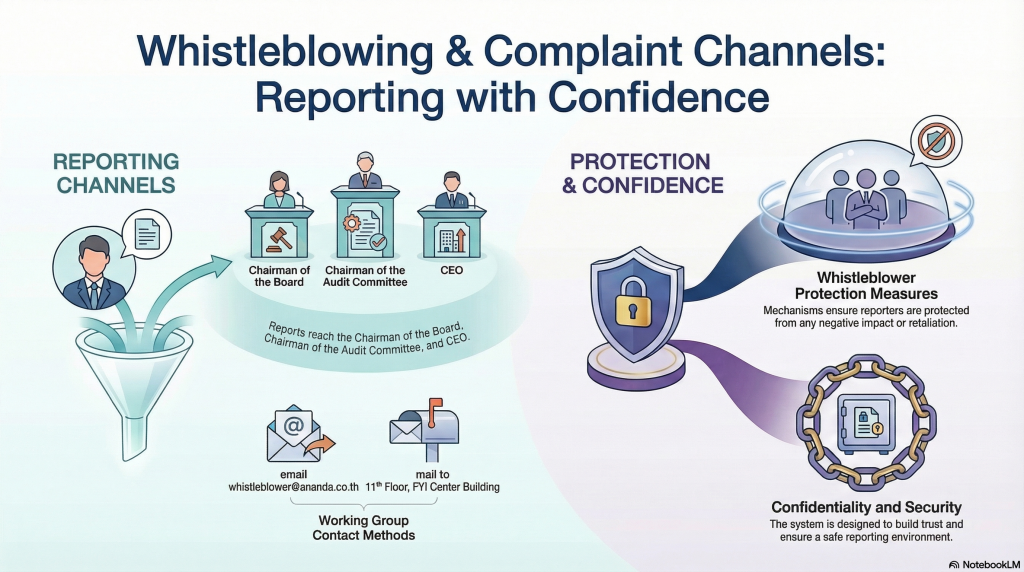
Protection Measures for Whistle blowers
The whistle blower can choose to remain anonymous in case he/she anticipates damage, but must indicate sufficiently clear details, facts or evidence which can constitute reasonable grounds to believe that an act in violation of laws, or breach of the Company’s regulations or code of conduct has taken place.
In case the whistle blower anticipates danger or damage, he/she can request the complaint recipient to provide appropriate protection measures, or else the complaint recipient may establish ones without the whistle blower’s request if the case is deemed to potentially cause damage or danger.
In case the whistle blower or other person affected by the complaint is unjustly or inappropriately treated by an employee or complaint recipient of the Company, it is deemed that said employee or complaint recipient has committed a gross breach of discipline and is thus subject to disciplinary action, including legal action if such act violates the laws.
Any person undergoing trouble or damage shall be relieved from such distress through appropriate and fair means or process.
Whistleblowing or Complaint Handling
The Company has established a complaint handling process, fact findings and complaints solving complaints to ensure that the Company properly handles received complaints in accordance with good corporate governance principles with the following guidelines:
When the Company receives clues or complaints through various channels specified by the Company. The investigative department is responsible for recording, receiving cases, searching for information, facts and evidence documents and present information, documentary evidence for the working team of receiving complaints and clues to consider the receiving complaints and notifying clues to investigate the facts from the evidence presented.
After completed investigating the facts and evidence, the working team of receiving complaints and clues will nominate authorized persons as specified by the Company to proceed with appropriate and fair damage mitigation and to appoint the Investigation Committee to investigate the facts in detail.
The Investigation Committee will proceed investigation process, prepare a summary of results report of the investigation, all related persons, cause, punishment plan of involved persons, corrective actions and setting measures to prevent or reduce the likelihood in the future.
The Investigation Committee presents a summary report on the results of the investigation to the Board of Directors or authorized persons designated by the Company for acknowledgment and to take action on punishment, correction and prevention as suggested by the Investigation Committee in the summary of investigation report and report to the Audit Committee for acknowledgment.
Number of Whistleblowing Cases
| Metric | Current Year | Previous Year | Two Years Ago |
|---|---|---|---|
| Total number of cases or issues received through whistleblowing channels (cases) | 0 | 0 | 0 |
Selection of Directors & Chief Executives
Directors & Chief Executives — Introduction
The nomination of the Chief Executive Officer, who is highest executive of the organization, will be preliminary considered by the Executive Committee. The Executive Committee will seek a qualified candidate with knowledge, skills, and experience that are beneficial to the Company's operations, well understanding the Company’s businesses and can manage to achieve the objectives and goals set by the Board of Directors.
Are Directors Selected Through the Nomination Committee?
Yes
Are Chief Executives Selected Through the Nomination Committee?
Yes
Rights of Minority Shareholders on Director Appointment
The company recognizes the importance of treating all shareholders equally and, in adherence to good corporate governance principles, provides an opportunity for shareholders to exercise their rights by nominating qualified individuals for consideration as directors of the company. This process is governed by clear and transparent criteria and conditions.
Individual shareholders eligible to nominate directors must hold no less than 0.05% of the total voting rights, equivalent to 1,666,500 shares (with evidence of shareholding required). This can be done either individually or collectively with other shareholders. Additionally, the nominating shareholder(s) must maintain their shareholder status on the date of the nomination.
The company has established specific criteria and conditions for nominating directors, which are clearly outlined and made available on the company's website. This ensures accessibility and transparency for all shareholders, reflecting the company's commitment to promoting good corporate governance and encouraging shareholder participation in the organization's management processes.
Method of Director Appointment
| Method |
|---|
| Method whereby each director requires approval votes more than half of the votes of attending shareholders with voting rights |
Selection of Independent Directors
Criteria for Selecting Independent Directors
The Board of Directors has assigned to the Nomination and Remuneration Committee to consider the selection of qualified persons under the Securities and Exchange Act including other relevant laws and other qualifications as defined by the Company. After that, such qualified persons will propose the Board of Directors or the meeting of shareholders to consider the appointment (as the case may be) in accordance with the Company's Articles of Association.
Procedure to propose for the election/appointment of directors, to begin with the Nomination and Remuneration Committee will review the qualifications and diversity of the skills, knowledge, expertise and experience of the Board Skills Matrix, as well as the overall composition of the Board to be in line with the Company's strategy and business direction annually. The Nomination and Remuneration Committee will consider not limit to gender, race, religion, age, and other specialized abilities including the dedication of time for their duties and performance. To appoint a new director, the Nomination and Remuneration Committee will prepare a Board Skills Matrix to determine the qualifications of the directors to be selected by considering the necessary skills that are still lacking in the Board. The Company also determined that at least one non-executive director is required to have knowledge, ability and understanding of the Company's business. In addition, the Nomination and Remuneration Committee will consider the database of Director Pool or may consider the Professional Search Firm Database as the case may be. In addition, the Nomination and Remuneration Committee will receive the suggestions from minority shareholders who will nominate persons proposed to be elected as directors because the Company provides opportunity to shareholders to nominate persons to be elected as directors at the Annual General Meeting of Shareholders according to the criteria set by the Company.
Independent Directors
Having of the qualifications and possesses no prohibited characteristics under Public Limited Companies Act, the Securities and Exchange Act, and relevant laws.
Having knowledge, capabilities, integrity and business ethics and sufficient time dedicated to the Company.
Every director must not hold directorship of more than 5 listed companies excluding subsidiaries. In case a director will take a position of director or executive in any listed company must notify to the Board of Directors in advance before accepting such positions to consider the appropriateness of the composition of the Board of Directors.
Hold shares not exceeding 0.75 percent of the total number of voting rights of the Company, its parent company, subsidiary, affiliate, major shareholders or controller persons of the Company, including the shares held by related persons of the Independent Director.
Neither being nor having been an Executive Director, employee, or advisor who receives salary or controlling person of the Company, its parent company, subsidiary, affiliate, same-level subsidiary, major shareholders or controller persons of the Company, except they have ended the foregoing relationship not less than two years before the date of application to the Securities and Exchange Commission. The prohibition does not include cases where the Independent Director used to be a public servant or consultant of government agencies which is a major shareholder or controlling persons of the Company.
Not being a person related by blood or registration under laws, such as in the manner of father, mother, spouse, sibling, and child, including spouse of children, executives, major shareholders, controlling persons, or persons to be nominated as directors, executives or controlling persons of the Company or its subsidiary.
Not having any business relationship with the Company, its parent company, subsidiaries, affiliates, major shareholders or controller persons of the Company, in any manner that may interfere with his or her independent judgment, and not be, or used to be, a substantial shareholder or controlling person in its parent company, subsidiaries, affiliates, major shareholders or controller persons of the Company, except they have ended the foregoing relationship not less than two years before being appointed.
The business relationship in paragraph one includes normal business transactions for the purpose of business operations, rental or lease of immovable property, transaction related to assets or services, or grant or receipt of financial assistance through receiving or extending loans, guarantee, providing assets as collateral, including any other similar actions, which result in the Company or its counterparty being subject to indebtedness payable to the other party in the amount of three percent or more of the net tangible assets of the Company or twenty million Baht or more, whichever is lower. The amount of such indebtedness shall be calculated according to the calculation method for value of connected transactions under the Notification of the Capital Market Supervisory Board Re: Rules on Connected Transactions mutatis mutandis. The consideration of such indebtedness shall include indebtedness taking place during one year prior to the date on which the business relationship with the person commences.
Neither being nor having been an auditor of the Company, its parent company, subsidiaries, affiliates, major shareholders or controller persons of the Company, and not having been a substantial shareholder, controlling person or partner of an audit firm which employs auditors of the Company, its parent company, subsidiaries, affiliates, major shareholders or controller persons of the Company, except they have ended the foregoing relationship not less than two years before being appointed.
Neither being nor having been any professional advisor including legal advisor or financial advisor who receives an annual service fee exceeding two million Baht from the Company, its parent company, subsidiaries, affiliates, major shareholders, or controller persons of the Company, and not having been a substantial shareholder, controlling person or partner of the professional advisor, except they have ended the foregoing relationship not less than two years before being appointed.
Not being a director who has been appointed as a representative of the Company’s director, major shareholder or shareholders who are related to the Company’s major shareholder.
Not conduct any business of the same nature as the Company’s or its subsidiaries’ businesses and is in competition with them in any material respect, nor being a substantial partner, shareholder holding more than one (1) percent of the voting shares of any company whose business is of the same nature as the Company’s or its subsidiaries’ businesses and is in competition with them in any material respect.
Not having any other manners, which may render him or her incapable of expressing independent opinions regarding the Company’s business affairs.
Independent Directors of the Company is independence from the management and major shareholders.
The Process of Directors’ Appointment
In case of Directors who vacate the office due to the retirement
When a position becomes vacant with term completion, the Nomination and Remuneration Committee will consider and nominate persons with suitable qualifications and propose them to the Board and shareholders for approval from the Annual General Meeting of Shareholders for re-appointment them for another term. The Nomination and Remuneration Committee will consider the several factors including the performance, meeting attendance and participation in the meeting.
The directors’ election complies with the Company’s Articles of Association and other relevant laws. The criteria and methodology of directors’ election at a shareholders’ meeting are as follows:
Each shareholder’s votes equal to his or her number of shares held, one share per one vote.
In voting of directors’ election, vting is to be done for individual directors, forwhich each shareholder is to exercise his or her entirevotes for individual directors, one by one.
To pass the resolution for director appointment, itrequires a majority vote of the shareholders who arepresent at the meeting and entitled to vote.
The person who receives the highest number of votes in descending order is elected as the number of directors to be elected. In the case where a person who has been elected in the next order has the same number of votes in excess of the number of directors to be elected or elected at that time. The chairman of the meeting shall have the casting vote.
In case of the directors’ vacancy due to any reasons other than the expiration of the term
The Nomination and Remuneration Committee will seek qualified persons to be nominated to the Board for consideration the appointment directors in replace of the resigned director(s) at the next Board meeting. An exception applies if the remaining term is less than two months, in which case an approval is required from the Annual General Meeting of Shareholders. In any case, the term of the replacement director is only as long as that of the resigned one. The resolution of the Board in this case must be required not less than three-fourths of the remaining directors on the Board.
Did Any Independent Director Have a Business or Professional Relationship?
No
Director Development
Development of Directors in the Past Year
The Board of Directors has a policy to promote and support continuous and regular training and education for directors and executives to ensure that they possess modern skills, knowledge, and understanding that align with changes in the business environment. This is to ensure that such skills and knowledge are beneficial to their duties on the Board of Directors and sub-committees. Additionally, all members of the Board of Directors have completed the fundamental training courses specifically designed for directors, organized by the Thai Institute of Directors Association (IOD). This aims to enhance the standards of good corporate governance and improve the company's operational efficiency.
Qualifications for Director Selection
| Qualification | Skill & Expertise |
|---|---|
| Having knowledge, skills, and experience in the real estate development business or possessing essential and beneficial skills for the company's operations. | 112 · Description: Economics · 130 · Description: Property Development · 152 · Description: Data Analysis · 155 · Description: Brand Management · 1683 · Description: Business Administration |
Evaluation of Board & Subcommittee Performance
Criteria for Evaluating Board Performance
The Company conducted the annual performance evaluation of the Board of Directors and Sub-Committees both of as a whole board and individual basis. The evaluation form has the objectives to use the evaluation results to benefit in reviewing operations, issues, or obstacles during the past year.
Process and Criteria for Performance Evaluation
The Company has evaluated the performance of the Board of Directors and Sub-Committees annually, both of as a whole board and individual basis in which the evaluation of the Board's performance has criteria for evaluation divided into 6 topics which are:
Structure and qualifications of the Board of Directors
Board meetings
Roles and responsibilities of the Board of Directors
Relationship between the Board of Directors and management
Board performance
Self-development of directors and executives.
For the performance evaluation of the sub-committees, the evaluation criteria are divided into 3 topics which are
The structure and qualifications of the sub-committees
The sub-committee’s meetings
The roles, duties, and responsibilities of the sub-committees.
The process of performance evaluation of both as a whole and individual basis, which is at the end of every year the Company Secretary/Secretary of the sub-committees, send the evaluation form to the Board of Directors/Sub-Committees to evaluate the annual performance.
Evaluation of Board Performance in the Past Year
Based on the performance evaluations for the year 2025, the results were rated as "Very Good to Excellent."
Evaluation Results
| Evaluated Body | Group — Carried Out? | Group — Grade / Average Score | Group — Grade / Full Score | Individual (Self-Assessment) — Carried Out? | Individual (Self-Assessment) — Grade / Average Score | Individual (Self-Assessment) — Grade / Full Score | Cross (Assessing Other Directors) — Carried Out? |
|---|---|---|---|---|---|---|---|
| Board Of Director | Y | 92.70 | 100 | Y | 94.00 | 100 | N |
| Audit Committee | Y | 100 | 100 | Y | 100 | 100 | N |
| Other Subcommittee | Y | 92.70 | 100 | Y | 98.70 | 100 | N |
| Other Subcommittee | Y | 98.10 | 100 | Y | 98.80 | 100 | N |
| Other Subcommittee | Y | 98.20 | 100 | Y | 95.40 | 100 | N |
| Executive Committee | Y | 87.70 | 100 | Y | 91.40 | 100 | N |
Subcommittees
Subcommittees
| Results of the Subcommittee's Duty Performance |
|---|
The performance of the Risk Management Committee was reported to the Board of Directors on a quarterly basis. The Risk Management Committee’s performances in 2025 were as follows:
In summary, in 2025, the Risk Management Committee performed its duties according to its responsibilities as stipulated in the Risk Management Committee Charter with the cooperation of management and employees across all departments, to enable the Company to achieve its objectives and deliver optimum benefits to shareholders and all stakeholder groups. |
The Nomination and Remuneration Committee held 3 meetings. Duties were performed in accordance with the scope, authority, duties, and responsibilities and the charter approved by the Board of Directors summarized as follows:
To consider the nomination of directors in replacement of those who are retried by rotation in the 2025 Annual General Meeting of Shareholders and provided shareholders an opportunity to nominate suitable people to be considered as the Company's directors for a period of four months in advance. There were no candidates nominated to the Company. Therefore, the Nomination and Remuneration Committee considered and nominated
to be re-appointed. Those candidates were qualified by law and in relation to the Company's business strategy to be re-elected for another term. The Shareholders' meeting resolved to approve in accordance with the recommendation of the Nomination and Remuneration Committee.
3. Improvement and Development of Duties
The Nomination and Remuneration Committee are committed to their duties with transparency and accuracy in accordance with the Rules set forth with the principles of good corporate governance for the maximum benefits, resulting in the creation of value added for the Company in the long run. |
In 2025, The Good Corporate Governance and Sustainable Development Committee held a total of one meeting, performing its duties within the scope of authority, responsibilities, and duties as outlined in the charter approved by the Board of Directors.
|
Meeting Attendance & Remuneration
Justification for Directors' Non-Attendance
Business trip
Types of Remuneration of the Board of Directors
The 2025 Annual General Meeting of Shareholders, held on April 24, 2025, resolved to approve the remuneration for directors for the year 2024 in an amount not exceeding 12,000,000 baht, same as last year’s, including
Monthly fee which is paid according to the duties and responsibilities of each director
Meeting fee which pays for attending of each meeting, it is paid only to non-executive directors.
Bonus which is paid under the considering the profits of the Company and the amount of dividends paid to shareholders.
Remuneration or Benefits Payable to the Board
| Metric | Amount (Baht) |
|---|---|
| Remunerations or benefits pending payment to the board of directors over the past year (baht) | 0 |
Supervision of Subsidiaries & Associated Companies
Does the Company Have Subsidiaries or Associated Companies?
Yes
Is There a Mechanism for Overseeing Subsidiaries and Associated Companies?
Yes
Mechanism for Overseeing Management of Subsidiaries
The Company has established key guidelines for governing the operations of its subsidiaries and joint ventures to ensure alignment with the company’s policies, as well as compliance with laws, regulations, announcements, rules, and relevant guidelines issued by the Securities and Exchange Commission (SEC) and the Stock Exchange of Thailand (SET).
The Company has implemented plans and measures to ensure that subsidiaries and joint ventures disclose accurate, complete, and reliable information regarding their performance, financial status, and other required disclosures to regulatory authorities, government agencies, external investors, and the public. In cases where subsidiaries and/or joint ventures need to engage in related-party transactions or transactions that may lead to conflicts of interest, the company monitors such transactions to ensure transparency and fairness. The company strictly adheres to the regulations governing related-party transactions and the acquisition and disposal of assets as prescribed by relevant regulatory authorities.
The Company conducts its business through various projects under its subsidiaries and joint ventures. The Board of Directors oversees each subsidiary and joint venture within the following scope:
.The Board of Directors assigns the Executive Committee to oversee that each subsidiary and/or joint venture complies with laws, objectives, regulations, board resolutions, and shareholder meeting resolutions. This includes adherence to good corporate governance policies and business ethics with integrity (Duty of Loyalty), diligence (Duty of Care), accountability, and ethics.
The Executive Committee is tasked with continuously monitoring the performance of subsidiaries and/or joint ventures and providing recommendations to ensure that their operations meet the defined objectives and that any arising challenges are addressed promptly and appropriately.
The Executive Committee ensures that subsidiaries and/or joint ventures comply with corporate governance policies and maintain effective and efficient internal control systems. The Internal Audit Office is assigned to audit the operations of subsidiaries and/or joint ventures to ensure proper implementation of policies and the adequacy of internal controls.
The Executive Committee is responsible for regularly reviewing and updating policies and key business plans of subsidiaries and/or joint ventures to ensure their relevance and alignment with current business conditions.
Additionally, the company appoints representatives to serve as directors in subsidiaries and/or joint ventures based on the company’s shareholding proportion or as stipulated in agreements regarding the appointment of representatives to the boards of subsidiaries and/or joint ventures.
Oversight Mechanisms
| Mechanism |
|---|
| Sending representatives to act as directors, executives or controlling persons in proportion to shareholdings |
| Disclosure of financial information and operating results |
| Internal control system of the subsidiary operating the core business is appropriate and sufficient in the subsidiary operating the core business |
| Acquisition or disposal of assets |
| Transactions between the Company and related persons |
| Defining the scope of powers, duties and responsibilities of directors and executives who represent the company in setting important policies |
Board Duty Performance — Overview
Board Duty Performance — Overall Description
To perform their duties in accordance with the law, the Company’s objectives, Articles of Association and resolutions of Board meetings and shareholders’ meetings with responsibility, care, and honesty.
To approve the vision, business strategies, business direction, business policy, target guidelines, operational plan, and annual budget as prepared by the Executive Committee and the Management, with pertinent reviews thereof at least once a year.
To oversee the management and performance of the Executive Committee, Chief Executive Officer, Management, or any other person assigned to perform such duties, to conform with any policies set out by the Board.
To continuously monitor the Company’s performance to be in line with the action plan and budget of the Company.
To ensure that the Company and its subsidiaries adopt an appropriate and efficient accounting system and to ensure that it has internal control and internal audit systems.
To ensure that the Company prepare balance sheet and profit and loss statements at the end of the Company’s accounting period to propose to the annual general meeting of shareholders for further approval.
To consider and approve the selection and nomination of the auditors and to determine the audit fee as proposed by the Audit Committee, prior to presenting it at the annual general meeting of shareholders for further approval.
To ensure that the Company has a written corporate governance policy and to efficiently adopt such policy to ensure that the Company is equally responsible to each group of stakeholders.
To consider the appointment of a person who has the qualifications and does not have prohibited character as prescribed under the Public Limited Company Act B.E. 2535 (1992) (as amended) and the Securities and Exchange Act B.E. 2535 (1992) (as amended), as well as any relevant notifications, rules and/or regulations, to be a director in the event there is a vacancy on the Board due to any reason other than retirement by rotation, and to consider and approve the appointment of directors in replacement of directors retiring by rotation, and to determine the remuneration of directors as proposed by the Nomination and Remuneration Committee, before further submitting to a shareholders’ meeting for approval;
To consider the appointment of sub-committees such as the Audit Committee, the Risk Management Committee, the Nomination and Remuneration Committee, the Good Corporate Governance and Sustainability Development Committee and the Executive Committee or any other sub-committees, and to determine the power and responsibilities of such sub-committees to support the performance of the Board.
To determine and change the authorized directors to sign on behalf of and to bind the Company.
To consider the appointment f executives in accordance with the definition prescribed by the SEC or the Capital Market Supervisory Board and to appoint the Company’s Secretary.
To seek professional advice from third-party organizations if it is necessary to make a proper decision.
To put in place and monitor comprehensive internal control and risk management systems that cover all risks including financial and operational ones to ensure compliance with relevant laws, rules and regulations, to supervise to ensure that the Management adopts an efficient risk management system or process, and to put in place an efficient check-and-balance mechanism for safeguarding the Company’s assets.
To put in place a policy against abuse of inside information, putting emphasis on the good corporate governance to maintain transparency and to prevent the abuse of non-public information for personal interest.
To manage and resolve possible conflicts of interest and connected transactions, and to meticulously review significant transactions to bring utmost benefits to the shareholders and stakeholders.
To formulate a policy on directors’ and executives’ reporting of interests.
To put in place an efficient anti-corruption system, to ensure that the Management places much importance on countering corruption as well as complying with anti-corruption measures.
To arrange for the orientation program, preparation of documents and necessary information for new directors in discharging their duties, including the induction session on the nature of the Company’s business and operations.
To encourage the Company’s directors, executives, and Company Secretary to participate in the Thai Institute of Directors’ seminars relating to the duties and responsibilities of directors and executives, in order to enhance their knowledge and competence conducive to good corporate governance, raise professional standard of directorship as well as provide best practice guidelines for directors in discharging their duties efficiently on par with international standards.
However, the Board of Directors, or its grantee, shall not approve transactions in which the Board of Directors or its grantee, or any person who may have any conflict of interest (as defined in the notification of the SEC or the Capital Market Supervisory Board) or may benefit in any manner which may give rise to a conflict with the Company or its subsidiaries, except where the approval of such transaction is consistent with the policy and criteria approved at a meeting of shareholders or Board meeting.
Audit Committee Duty Performance
Results of the Audit Committee's Duty Performance in the Past Year
In 2025, The Audit Committee performed its duties as assigned by the Board of Directors and in accordance with the Audit Committee Charter, which is aligned with the requirements of the Stock Exchange of Thailand. The Committee focused on reviewing the financial statements; considering connected transactions or transactions that may involve conflicts of interest; reviewing compliance with applicable laws and regulations; and reviewing the internal control system, in order for the Company to operate efficiently and effectively in achieving its core objectives, vision, strategies, and business plans amid intense competition and rapid changes in the business environment, under good corporate governance and proper management in compliance with laws, rules, and internal auditing standards. In addition, the Audit Committee gave due consideration to audit findings and recommendations made by the external auditor. In 2025, the Audit Committee held one meeting with the external auditor without the presence of management to independently discuss significant matters relating to the preparation of the financial statements, including the solicitation of professional opinions. This resulted in further improvements in the appropriateness and rigor of financial reporting, as well as the enhancement of the Company’s internal control system.
The Audit Committee held 11 meetings and performed its responsibilities as follows.
1. Review of Financial Statements
The Audit Committee reviewed the quarterly and annual financial statements, including the consolidated financial statements of the Company and its subsidiaries, which were reviewed and audited by the external auditor. In this regard, the Audit Committee held meetings with the external auditor, management, and the internal audit function, and made inquiries of the external auditor and management regarding the material accuracy of the financial reports and the adequacy of disclosures. Except for the potential impact arising from the qualified conclusion related to the legal case concerning the Ashton Asoke project, the Company’s financial statements were issued with an unqualified opinion. The external auditor did not identify any matters that would cause them to believe that the interim financial information was not prepared, in all material respects, in accordance with Thai Accounting Standard No. 34 on Interim Financial Reporting. Furthermore, the audit of the Company’s annual financial statements indicated that the operating results and cash flows for the year were presented fairly, in all material respects, in accordance with Financial Reporting Standards, with adequate and timely disclosure of material information in compliance with applicable laws and official notifications, as well as the regulations of the Stock Exchange of Thailand and the Securities and Exchange Commission.
The Audit Committee reviewed the Company’s quarterly Management Discussion and Analysis (MD&A) reports that were communicated to investors or relevant parties, in accordance with the Audit Committee’s good practice guidelines for the prevention and deterrence of improper conduct by listed companies as prescribed by the Securities and Exchange Commission.
In addition, the Audit Committee held separate meetings with the external auditor without the presence of management to allow for independent discussions regarding access to information, the adequacy of information support provided by management, the audit of material information used in the preparation of the financial statements, Key Audit Matters, and the auditor’s independence in the performance of their duties. The external auditor confirmed that they received full cooperation from management in the review of the financial statements and did not identify any suspicious or irregular circumstances.
2. Consideration of Connected Transactions or Transactions with Conflict of Interest
The Audit Committee reviewed and provided opinions on connected transactions or transactions that may give rise to conflicts of interest of the Company and its subsidiaries, and reviewed the disclosure of such transactions to ensure that the execution of connected transactions or transactions that may involve conflicts of interest, including acquisitions or disposals of the Company’s assets, was conducted fairly, at market prices, and in the ordinary course of business (fair and at arm’s length). Such transactions were supported by appropriate rationale and documentation, were accurate and complete, complied with the notifications of the Securities and Exchange Commission, and were in accordance with the Company’s policy on related party transactions, with due regard to the interests of all stakeholders. In this regard, the Audit Committee provided recommendations for the management to review the business conditions to be more concise and in line with the current environment.
3. Review of the Company’s compliance with the Securities and Exchange Act, the Regulations of the SET and Laws related to the Company’s Business
The Audit Committee has reviewed Connected Transactions Policy including the process of asset acquisition and disposal to comply with the Notification of the Securities and Exchange Commission (SEC) and the Stock Exchange of Thailand. The Audit Committee provided the opinions and recommendations as essential for the Company to comply with the Securities Exchange Act, including related laws, and reviewed the Company's operations to ensure compliance with the rules, regulations, policies, and operational manuals.
4. Evaluation of Internal Control Review
The Audit Committee reviewed the adequacy of the internal control system by reviewing the internal audit report as well as the external auditor report quarterly to ensure the Company has adequate internal control system and monitored the completion of the actions defined in the audit report to ensure that the Company has an effective internal control system, risk management and good corporate governance.
The Audit Committee oversaw the whistleblowing management process to ensure that the company provided the whistleblowing channel and developed the policy and process to handle the whistleblowing including fraud and corruption and complaints properly. The Audit Committee provided recommendations on the corrective and preventive actions for the Company to manage the incidents properly and effectively, to prevent such incidents in the future, and the investigation standard, the conclusion of the investigation, as well as Whistleblowing Policy and procedure.
5. Supervision of Internal Audit Department
The Audit Committee has supervised the Internal Audit Department covering the scope of work, the scope of responsibilities, communication to relevant functions, and independence to perform internal audit duties .The Audit Committee reviewed and approved the internal audit plan which was developed in accordance with the company risk profile, and the auditor’s observations, reviewed the internal audit reports, provided recommendations to the Internal Audit Department, and monitored the actions specified in the internal audit reports. The Internal Audit Department has performed its duties in accordance with the plan and has allocated the resources to perform the special assignments. The Audit Committee focused on the development of the internal audit resources, as well as focused on working with the Risk Management Department and other departments. The Audit Committee provided recommendations and advice on the improvement of the internal audit system with the aim of the good corporate governance and internal control adequacy.
6. Consideration for Nomination of the External Auditor and the Determination of the Audit Fee
The Audit Committee appraised the performance of the external auditor in 2024 and found that the auditor had knowledge, competence, independence and has performed the duties in accordance with the auditing standards. The external auditor proposed the audit plan and performed the duties as planned. The auditor was able to work and coordinate with all relevant parties, as well as providing constructive recommendations to the Company, resulting in improvements in the organization. In conclusion, the performance of the auditor was satisfying. Therefore, the Audit Committee considered nominating EY Office Limited as the Company’s auditor and determining the audit fee for the fiscal year 2025. The Audit Committee proposed the nomination of EY Office Limited as the Company’s auditor in 2025 and the determination of the audit fee to the Board of Directors for consideration and to the Shareholders for approval in the Annual General Meeting of Shareholders.
7. Reporting of Audit Committee Performance to the Board of Directors
The Audit Committee reported its performance, the review of the financial statements, and the review of the internal audit report to the Board of Directors on a quarterly basis and prepared the Audit Committee Report for disclosure in the annual report as specified by the Stock Exchange of Thailand and Audit Committee Charter.
In summary, in 2025, the Audit Committee discharged its duties as stipulated in the Audit Committee Charter by reviewing, in all material respects, the Company’s financial reports prepared in accordance with generally accepted accounting standards, ensuring adequate disclosure of information, and considering connected transactions or transactions that may give rise to conflicts of interest, in order to ensure the Company’s compliance with applicable laws, the internal control system, and the requirements of the Stock Exchange of Thailand. The Committee also oversaw the risk management system in accordance with the framework of The Committee of Sponsoring Organizations of the Treadway Commission (COSO), to ensure that the Company is managed in accordance with the principles of good corporate governance and continues to grow with due regard to its stakeholders.
Executive Committee Duty Performance
Results of the Executive Committee's Duty Performance in the Past Year
In 2025, the Executive Committee strictly performed its duties as assigned by the Board of Directors, adhering to the scope of authority, duties, and responsibilities outlined in the Executive Committee Charter, the Manual of Authorities, and the company policies approved by the Board of Directors. The key operational details are as follows:
The Executive Committee held a total of 34 meetings to review, screen, and approve significant matters beneficial to business operations, as well as to monitor performance in alignment with the strategic plans. Each meeting was attended by no less than half of the total members of the Executive Committee to ensure effective execution of its duties.
The Executive Committee reviewed, approved, and screened various agendas, as well as acknowledged the business operations of the company, its subsidiaries, and joint ventures, covering four main areas as follows:
Legal, Litigation, and Regulatory Compliance
Reviewed and monitored the progress of significant legal cases
Ensured that business operations complied strictly with laws, regulatory requirements, and the company’s rules and regulations.
Finance and Credit
Reviewed, screened, and approved funding sources, credit management, and financial planning to ensure the company maintained adequate liquidity for business operations and future expansion.
Business Operations, Investments, and Oversight of Subsidiaries and Joint Ventures
Reviewed and screened visions, strategic plans, and investment plans for new projects to align with the company’s business direction.
Closely monitored the management of subsidiaries and joint ventures to ensure compliance with good corporate governance policies and the business ethics of the group.
Monitored performance and provided recommendations to the management of affiliated companies to address obstacles and potential issues promptly.
Budget and Expenditures
Reviewed and screened the annual budget and monitored budget utilization to ensure cost-effectiveness and alignment with the plans approved by the Board of Directors.
The Executive Committee prepared summary reports on its performance, including quarterly operational reports and key issues, which were regularly presented to the Board of Directors every quarter. This ensured that daily management was conducted transparently and achieved the organization’s ultimate objectives.