

CG Structure · 2025
In this section21 topics
- Board Composition9 items
- Board of Directors2 items
- Board Meetings & Remuneration5 items
- Balance of Power Between the Board and Management3 items
- Board Roles, Duties and Charter3 items
- Other Board Governance Matters1 item
- Audit Committee4 items
- Executive Committee2 items
- Other Subcommittees1 item
- Executives1 item
- Executive Remuneration5 items
- Remuneration Policy3 items
- Employees1 item
- Provident Fund3 items
- Policy for Employees Not in the Provident Fund5 items
- Auditors and Audit Fees2 items
- Company Secretary and Other Assigned Persons4 items
- Investor Relations Contact2 items
- Representatives in Thailand (Foreign Companies)1 item
- Executive Committee Members Who Left During the Year1 item
- Other Subcommittees — Members Who Left During the Year1 item
Board Composition
Board Composition — Introduction
The Board of Directors consists of 10 members in total, comprising 9 male directors (90%) and 1 female director (10%). In terms of roles and responsibilities, the Board is equally divided between 5 executive directors (50%) and 5 non-executive directors (50%). Of the non-executive directors, 4 are independent directors (40%) and 1 is a non-executive director who does not hold an independent director position (10%).
Total Number of Directors
10
Male Directors
9
Female Directors
1
Independent Directors
4
Non-executive Directors
5
Non-executive Directors Who Are Not Independent
1
Executive Directors
5
Total Board Meetings Held
8
Board of Directors
Board of Directors — Introduction
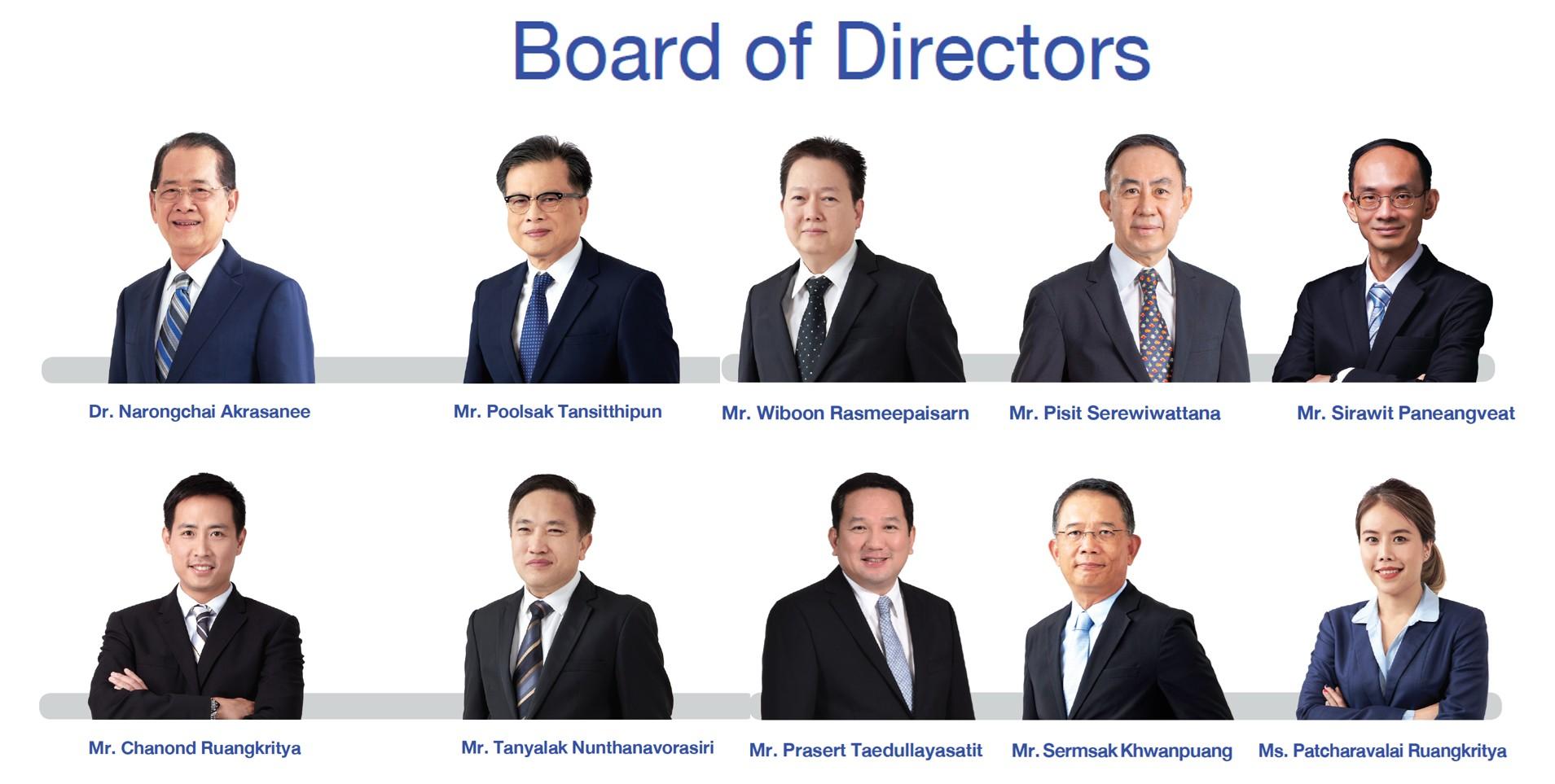
Directors
| Title | Title — Please Specify | First Name | Last Name | Gender | Year of Birth | Nationality | Resident in Thailand? | Position | Executive or Non-executive | Independent Director? | Director Type | Appointment Date | Authorised to Sign? | Related to Another Director or Executive? | Any Legal Violation in the Past 5 Years? | Highest Education | Field of Study | Skills & Expertise | Attended Director Training? | Director Accreditation Program (DAP)? | Director Certification Program (DCP)? | Board Meetings Held | Board Meetings Attended | AGMs Held | AGMs Attended | Meeting Allowance (Baht) | Other Remuneration (Baht) | Total Remuneration (Baht) | Non-monetary Remuneration | Shares Held | Shareholding (%) | Indirect Shareholding (held by whom) |
|---|---|---|---|---|---|---|---|---|---|---|---|---|---|---|---|---|---|---|---|---|---|---|---|---|---|---|---|---|---|---|---|---|
| other | Dr. | NARONGCHAI | AKRASANEE | M | 1,945 | 643 · Description: Thailand | Y | Chairman of the board | Non-executive | Y | Existing director | 2015-09-01T00:00 | N | N | N | Doctoral degree | Economics | 112 · Description: Economics | N | Y | N | 8 | 8 | 1 | 1 | 200,000 | 2,400,000 | 2,600,000 | 0 | Held common stock (ANAN) through Seranee Holdings Co., Ltd. in an amount of 1,503,000 shares or 0.036% | ||
| Mr. | POOLSAK | TANSITTHIPUN | M | 1,958 | 643 · Description: Thailand | Y | Vice Chairman | Non-executive | Y | Existing director | 2011-05-12T00:00 | N | N | N | Master's degree | Business Administration | 141 · Description: Law | N | Y | Y | 8 | 8 | 1 | 1 | 200,000 | 900,000 | 1,100,000 | 0 | ||||
| Mr. | WIBOON | RASMEEPAISARN | M | 1,961 | 643 · Description: Thailand | Y | Director | Non-executive | Y | Existing director | 2011-05-12T00:00 | N | N | N | Master's degree | Management | 143 · Description: Accounting · 165 · Description: Risk Management · 166 · Description: Audit · 167 · Description: Internal Control | N | Y | Y | 8 | 8 | 1 | 1 | 200,000 | 780,000 | 980,000 | 0 | ||||
| Mr. | TANYALAK | NUNTHANAVORASIRI | M | 1,964 | 643 · Description: Thailand | Y | Director | Executive | Continuing director (Full term of directorship and being re-appointed as a director) | 2011-05-12T00:00 | Y | N | N | Master's degree | Management | 1683 · Description: Business Administration · 141 · Description: Law · 140 · Description: Information & Communication Technology · 265 · Description: Governance/ Compliance | N | Y | N | 8 | 7 | 1 | 1 | 360,000 | 360,000 | 0 | 4,658,800 | 0.11 | ||||
| Ms. | PATCHARAVALAI | RUANGKRITYA | F | 1,981 | 643 · Description: Thailand | Y | Director | Executive | Existing director | 2011-05-12T00:00 | Y | Y | N | Bachelor's degree | Management | 137 · Description: Tourism & Leisure · 1683 · Description: Business Administration · 157 · Description: Project Management · 155 · Description: Brand Management · 154 · Description: Digital Marketing | N | Y | N | 8 | 7 | 1 | 1 | 360,000 | 360,000 | 0 | 207,062,625 | 4.97 | ||||
| Mr. | CHANOND | RUANGKRITYA | M | 1,973 | 643 · Description: Thailand | Y | Director | Executive | Continuing director (Full term of directorship and being re-appointed as a director) | 2011-05-12T00:00 | Y | Y | N | Master's degree | Finance | 112 · Description: Economics · 130 · Description: Property Development · 158 · Description: Corporate Management · 1683 · Description: Business Administration · 164 · Description: Strategic Management | N | Y | N | 8 | 7 | 1 | 1 | 360,000 | 360,000 | 0 | 1,392,952,464 | 33.43 | ||||
| Mr. | SERMSAK | KHWANPUANG | M | 1,960 | 643 · Description: Thailand | Y | Director | Executive | Existing director | 2011-05-12T00:00 | Y | N | N | Master's degree | Economics | 112 · Description: Economics · 130 · Description: Property Development · 144 · Description: Finance · 143 · Description: Accounting | N | N | Y | 8 | 8 | 1 | 1 | 360,000 | 360,000 | 0 | 3,033,750 | 0.07 | ||||
| Mr. | SIRAWIT | PANEANGVEAT | M | 1,975 | 643 · Description: Thailand | Y | Director | Non-executive | N | Existing director | 2020-04-28T00:00 | N | N | N | Master's degree | Business Administration | 130 · Description: Property Development | N | Y | N | 8 | 8 | 1 | 1 | 200,000 | 780,000 | 980,000 | 0 | 1,312,500 | 0.03 | Held common stock (ANAN) in an amount of 1,312,500 shares or 0.032% and held through spouse in and amount of 2,606,250 shares or 0.063% | |
| Mr. | PRASERT | TAEDULLAYASATIT | M | 1,968 | 643 · Description: Thailand | Y | Director | Executive | Existing director | 2020-08-03T00:00 | N | N | N | Master's degree | Finance | 143 · Description: Accounting · 142 · Description: Marketing · 144 · Description: Finance · 130 · Description: Property Development | N | Y | Y | 8 | 8 | 1 | 1 | 360,000 | 360,000 | 0 | ||||||
| Mr. | PISIT | SEREWIWATTANA | M | 1,961 | 643 · Description: Thailand | Y | Director | Non-executive | Y | Continuing director (Full term of directorship and being re-appointed as a director) | 2022-08-11T00:00 | N | N | N | Master's degree | Management | 146 · Description: Human Resource Management · 112 · Description: Economics · 265 · Description: Governance/ Compliance · 166 · Description: Audit | N | Y | Y | 8 | 8 | 1 | 1 | 200,000 | 900,000 | 1,100,000 | 0 |
Board Meetings & Remuneration
Date of the Annual General Meeting
2024-04-24T00:00
Was an Extraordinary General Meeting Held?
No
Board Meeting Allowance (Baht)
1000000.0
Other Board Remuneration (Baht)
7560000.0
Total Board Remuneration (Baht)
8560000.0
Balance of Power Between the Board and Management
Are There Measures Balancing the Board's and Management's Power?
Yes
Measures Balancing the Board's and Management's Power
The structure of the Board of Directors consists of 40% independent directors. The proportion of non-executive directors and executive directors is 50% and 50%, respectively. The company considers this structure and composition of the Board of Directors to be appropriate, as only 50% of the directors are executives. Meanwhile, the remaining 50% are independent and non-executive directors, which is a balanced proportion. This structure ensures the ability to balance the power of management and provide independent opinions effectively.
Methods Used to Balance Power
| Method |
|---|
| Appointment of an independent director Participate in determining the meeting agenda for the committee |
| Increasing the proportion of independent directors |
Board Roles, Duties and Charter
Does the Company Have a Board Charter?
Yes
Content of the Board Charter
Objectives
The Board serves as the representative of shareholders and plays a vital role in determining the direction, policies, goals, and business strategies to maximize investment returns and benefits for shareholders. The Board is also responsible for overseeing and monitoring the Management’s performance to ensure compliance with defined policies and strategies, while operating within the scope of the law, the Company's objectives, articles of association, and shareholders' resolutions.
Composition
The Board consists of the number of directors specified by the shareholders' meeting. At least one-third of the total number of directors, and no fewer than 3 directors, must be Independent Directors. At least half of the total number of directors must reside in Thailand.
The Chairman must not be the same person as the Chairman of the Executive Committee or the Chief Executive Officer to ensure a clear separation of roles and a balance of power.
Qualifications
The selection of individuals for election/appointment as directors shall be screened and proposed by the Nomination and Remuneration Committee. They will recommend qualified candidates to the Board of Directors for consideration. The individuals nominated for election/appointment as directors must possess the following qualifications:
Directors
1) Possess qualifications and have no prohibited characteristics under the Public Limited Companies Act, the Securities and Exchange Act, and other relevant laws.
2) Have knowledge, capabilities, expertise, and a diversity of skills and experiences beneficial to the Company's business, with sufficient time to dedicate to duties.
3) Possess leadership qualities and the ability to oversee Management performance effectively.
4) Hold directorships in no more than 5 listed companies on the Stock Exchange of Thailand.
Independent Directors, In addition to the qualifications in 4.1, Independent Directors must meet the criteria set by the Capital Market Supervisory Board, including:
1) Hold shares not exceeding 0.75 percent of the total number of voting rights of the Company, its parent company, subsidiary, affiliate, major shareholders or controller persons of the Company, including the shares held by related persons of the Independent Director.
2) Neither being nor having been an Executive Director, employee, or advisor who receives salary or controlling person of the Company, its parent company, subsidiary, affiliate, same-level subsidiary, major shareholders or controller persons of the Company, except they have ended the foregoing relationship not less than two years before the date of application to the Securities and Exchange Commission. The prohibition does not include cases where the Independent Director used to be a public servant or consultant of government agencies which is a major shareholder or controlling persons of the Company.
3) Not being a person related by blood or registration under laws, such as in the manner of father, mother, spouse, sibling, and child, including spouse of children, executives, major shareholders, controlling persons, or persons to be nominated as directors, executives or controlling persons of the Company or its subsidiary.
4) Not having any business relationship with the Company, its parent company, subsidiaries, affiliates, major shareholders or controller persons of the Company, in any manner that may interfere with his or her independent judgment, and not be, or used to be, a substantial shareholder or controlling person in its parent company, subsidiaries, affiliates, major shareholders or controller persons of the Company, except they have ended the foregoing relationship not less than two years before being appointed.
4) The business relationship in paragraph one includes normal business transactions for the purpose of business operations, rental or lease of immovable property, transaction related to assets or services, or grant or receipt of financial assistance through receiving or extending loans, guarantee, providing assets as collateral, including any other similar actions, which result in the Company or its counterparty being subject to indebtedness payable to the other party in the amount of three percent or more of the net tangible assets of the Company or twenty million Baht or more, whichever is lower. The amount of such indebtedness shall be calculated according to the calculation method for value of connected transactions under the Notification of the Capital Market Supervisory Board Re: Rules on Connected Transactions mutatis mutandis. The consideration of such indebtedness shall include indebtedness taking place during one year prior to the date on which the business relationship with the person commences.
5) Neither being nor having been an auditor of the Company, its parent company, subsidiaries, affiliates, major shareholders or controller persons of the Company, and not having been a substantial shareholder, controlling person or partner of an audit firm which employs auditors of the Company, its parent company, subsidiaries, affiliates, major shareholders or controller persons of the Company, except they have ended the foregoing relationship not less than two years before being appointed.
6) Neither being nor having been any professional advisor including legal advisor or financial advisor who receives an annual service fee exceeding two million Baht from the Company, its parent company, subsidiaries, affiliates, major shareholders, or controller persons of the Company, and not having been a substantial shareholder, controlling person or partner of the professional advisor, except they have ended the foregoing relationship not less than two years before being appointed.
7) Not being a director who has been appointed as a representative of the Company’s director, major shareholder or shareholders who are related to the Company’s major shareholder.
8) Not conduct any business of the same nature as the Company’s or its subsidiaries’ businesses and is in competition with them in any material respect, nor being a substantial partner, shareholder holding more than one (1) percent of the voting shares of any company whose business is of the same nature as the Company’s or its subsidiaries’ businesses and is in competition with them in any material respect.
9) Not having any other manners, which may render him or her incapable of expressing independent opinions regarding the Company’s business affairs.
Election/Appointment, Term of Office, and Vacation of Office
The election/appointment of the company's directors shall comply with the law, the company's regulations, and other relevant rules. The process must be conducted with transparency and clarity.
1. Election
In the event that a director vacates their position upon the expiration of their term, the shareholders' meeting shall consider electing a new director. The resolution for the election must be approved by a majority vote of the shareholders present at the meeting and casting their votes.
2. Appointment
In the event that a director's position becomes vacant for reasons other than the expiration of their term, the Board of Directors shall appoint a qualified individual, as specified in Clause 4 and free from any legal prohibitions, to fill the vacancy at the next Board meeting, unless the remaining term of the departing director is less than two months. The individual appointed to fill the vacancy shall serve only for the remaining term of the director they replace. The resolution to appoint such a replacement director must be approved by a vote of no less than three-fourths of the remaining directors.
The Nomination and Remuneration Committee shall select and propose a qualified candidate, taking into account the diversity of the Board's structure (Board Diversity). This includes consideration of diversity in professional skills, specific expertise, gender, race, religion, and age. The proposed candidate will then be submitted to the Board of Directors for appointment to the vacant position or, as the case may be, for nomination to the shareholders' meeting for election as a replacement director for a director whose term has expired.
The Board of Directors shall elect one director as the Chairman of the Board and may also elect a Vice Chairman and other positions as deemed appropriate.
3. Term of Office
1) At every annual general meeting, at least one-third of the directors must retire by rotation. If the number of directors cannot be divided into three equal parts, the number closest to one-third shall retire.
2) For the first and second years following the company's registration, the directors to retire shall be determined by drawing lots. In subsequent years, the directors who have held office the longest shall retire. Retiring directors may be considered for re-election as company directors.
3) Independent directors of the company may serve for no more than three consecutive terms or a maximum of nine years, unless the Nomination and Remuneration Committee reasonably determines that the continuation of the independent director's term is necessary, appropriate, and beneficial to the company.
4. Vacation of Office
1) Apart from retirement by rotation, the directors shall vacate office upon:
1) Death
2) Resignation
3) Lack of qualifications, or possession of legally prohibited characteristics
4) Removal by a resolution of the shareholders’ meeting by a vote of not less than threefourth of the total shareholders attending the meeting and entitled to vote and having an aggregate number of shares not less than onehalf of the total shares held by the shareholders attending the meeting and entitled to vote
5) Removal by a court order.
2) Any director who wishes to resign from their position must submit a resignation letter to the company. The resignation will take effect from the date the resignation letter is received by the company. The resigning director may also notify the Registrar of Public Limited Companies of their resignation.
3) In the event that the entire Board of Directors vacates their positions, the outgoing Board shall continue to act in their capacity to manage the company's affairs as necessary until the new Board assumes their duties, unless otherwise ordered by the court in cases where the Board vacates their positions by court order.
The outgoing Board, as stated in the first paragraph, must arrange a shareholders' meeting to elect a new Board of Directors within one month from the date of their departure. A notice of the meeting must be sent to shareholders at least 14 days prior to the meeting date, and the meeting notice must be advertised in a newspaper for three consecutive days, no less than three days before the meeting.
4) The shareholders' meeting may pass a resolution to remove any director from their position before the expiration of their term with a vote of no less than three-fourths of the shareholders present at the meeting and eligible to vote, provided that the shares held by these shareholders collectively account for no less than half of the total shares held by shareholders present and eligible to vote.
Roles, Duties, and Responsibilities
The Board of Directors
1) Perform duties within the scope of the law, objectives, and articles of association of the Company, as well as resolutions of the Board of Directors and shareholders' meetings, with Duty of Loyalty, Duty of Care, Accountability, and Ethics, while considering the equal benefit of all shareholders.
2) Define the Company's vision, mission, policies, strategies, and goals, including approving policies and operational directions proposed by Management, and supervising Management to ensure compliance with these objectives to increase economic value and shareholder wealth, while considering all stakeholders.
3) Prevent conflicts of interest among the Company's stakeholders.
4) Supervise the administration and performance of Management or any assigned persons to ensure operations align with the policies set by the Board of Directors.
5) Monitor and evaluate Management's performance to achieve strategies within the approved budget.
6) Ensure accurate, complete, transparent, reliable, timely, and equal disclosure of information to shareholders and all groups of stakeholders.
7) Establish a written Good Corporate Governance policy, support organization-wide communication and adherence, and regularly review the policy to ensure the Company operates with responsibility and fairness to all stakeholders.
8) Regularly review and update significant policies and plans to ensure they are current and suitable for the business environment.
9) Establish accounting and financial reporting systems, and ensure that processes for evaluating the appropriateness of internal control and internal audit are efficient and effective.
10) Establish an appropriate and efficient risk management process capable of assessing, monitoring, and managing significant risks.
11) Approve risk management policies, frameworks, and risk appetite, and oversee them to ensure that the Company's strategy and risk management are consistent with the accepted risk levels.
12) Establish a succession plan for the Company's senior executives.
13) Approve the acquisition or disposal of assets, investments, and any operations in compliance with relevant laws, announcements, requirements, and regulations.
14) Approve connected transactions in accordance with relevant laws and regulations, and establish clear and transparent processes for such transactions.
15) Seek professional opinions by hiring external consultants at the Company's expense when necessary to support appropriate decision-making.
16) Appoint sub-committees and their chairpersons to support the Board's operations as necessary, and regularly monitor their performance.
17) Appoint a qualified person to the position of Chief Executive Officer in the event of a vacancy.
18) Appoint a Company Secretary to support the Board and the Company in complying with relevant laws and regulations; the delegation of authority must not allow directors or authorized persons to approve transactions in which they or related persons may have a conflict of interest, except for approvals following policies or criteria already approved by the shareholders or the Board of Directors
The Chairman
The Chairman plays a leading role on the Board and has the following duties:
1) Call Board of Directors meetings and act as the Chairman of those meetings. In cases where a deciding resolution is required and the votes are equal, the Chairman shall have a casting vote.
2) Determine the Board meeting agenda in consultation with the Management to ensure that all significant matters are included in the agenda.
3) Conduct Board meetings according to the agenda, relevant legal requirements, and Good Corporate Governance principles. This includes allocating sufficient time and encouraging all directors to participate in discussions, exercise prudent discretion, and express their opinions independently.
4) Monitor and oversee the performance of the Board of Directors to ensure efficiency and the achievement of organizational goals
Meetings
Meetings must be held at least once every 3 months, with dates scheduled in advance for the entire year; extraordinary meetings may be called as necessary.
At least two directors have the right to request a meeting. In such cases, the Chairman or a designee must set the meeting date within 14 days of receiving the request.
To call a Board meeting, the Chairman, Company Secretary, or a designee must send a notice to all directors at least 7 days prior to the meeting. In urgent cases to protect the Company's rights or interests, notice may be given by other means and the meeting date may be set sooner.
A quorum for a Board meeting requires the presence of at least half of the total number of directors. The Chairman presides over the meeting. If the Chairman is absent or unable to perform their duties, the Vice Chairman shall preside. If there is no Vice Chairman or they are unable to perform their duties, the attending directors shall elect one director to act as the chairman of the meeting.
Decisions are made by a majority vote. Each director has one vote. In the event of a tie, the chairman of the meeting shall have a casting vote. Directors with a conflict of interest in any agenda item are not entitled to vote on that matter.
The Board has the authority to invite Management, executives, or relevant individuals to attend meetings to provide opinions or information for consideration.
The Company Secretary is responsible for recording the minutes and keeping meeting documents. In the event the Company Secretary vacates the position or is unable to perform their duties, a director designated by the Board shall perform these tasks.
Board Reporting
The Board must report its responsibility for preparing the financial reports, which shall be disclosed in the Company's Annual Report for shareholders' acknowledgment, containing at least the details required by relevant laws, rules, or regulations.
Performance Evaluation
The Board must conduct a performance evaluation annually, categorized into two formats:
1) Evaluation of the Board as a whole.
2) Individual evaluation (self-assessment).
The Company Secretary is responsible for preparing the evaluation forms, summarizing the results, and reporting them to the Board. These evaluation results must also be disclosed in the Annual Report.
Remuneration
Director's remuneration and compensation are determined by the shareholders' meeting. Directors are entitled to receive compensation in the form of rewards, meeting allowances, gratuities, bonuses, or other benefits according to the Company's Articles of Association or as considered by the shareholders' meeting. This may be set as a fixed amount or based on specific criteria, periodically or until changed. Additionally, directors shall receive travel allowances and welfare according to Company regulations. Employees or staff of the Company who are elected as directors shall still receive compensation and benefits in their capacity as employees or staff.
The Nomination and Remuneration Committee considers appropriate remuneration rates and proposes them to the Board for endorsement before presenting them to the shareholders' meeting for approval.
Director Development
New directors will receive an orientation covering the organization's overview, business operations, strategic plans, policies, laws, and regulations related to directors, presented by Management and/or the Company Secretary.
The Company encourages directors and executives to participate in various training and development programs, such as seminars and site visits, to enhance their knowledge and experience to stay current with changing situations, which is beneficial for their performance.
Charter Review
The Board of Directors shall review this Charter annually
Link to the Board Charter
https://investor.ananda.co.th/storage/downloads/charters/20220214-anan-bod-charter-en.pdf
Other Board Governance Matters
Board Governance Practices
| Practice | Yes / No |
|---|---|
| The chairman of the board and the highest-ranking executive are from the same person | N |
| The chairman of the board is an independent director | Y |
| The chairman of the board and the highest-ranking executive are from the same family | N |
| Chairman is a member of the executive board or taskforce | N |
| The company appoints at least one independent director to determine the agenda of the board of directors’ meeting | N |
Audit Committee
Audit Committee Charter
| Roles, Duties and Responsibilities | Type of Subcommittee | Link to the Charter |
|---|---|---|
Scope of Power, Duties and Responsibilities of the Audit Committee
1. To review and ensure that the Company provides a sufficient and accurate report of its financial statements.
2. To review and ensure that the Company has appropriate and efficient internal controls and internal audit systems, to consider the independence of the Office of Internal Audit Bureau, and to approve the appointment, transfer, and termination of employment of the Chief of Internal Audit Bureau or any other unit responsible for internal audit.
3. To review the summary of fraud investigation results and establish preventive measures, as well as review internal processes related to whistleblowing and complaint handling to ensure appropriate actions are taken.
4. To review and ensure that the Company complies with securities and exchange laws, regulations of the SET and the laws relating to the Company’s business.
5. To consider recruiting, nominating and terminating an independent third party to be the Company’s auditor and to determine the auditor’s fee, as well as to hold at least 1 meeting per year with the auditor without participation of the management.
6. To consider and ensure that the Company’s connected transactions or transactions that may result in conflicts of interest follow the law and the rules of the SET, and to ensure that such transactions are reasonable and in the best interest of the Company.
7. If the Company's auditor discovers any suspicious circumstances indicating that the Managing Director or any individual responsible for the Company's operations has committed an offense as specified under the Securities and Exchange Act, and subsequently reports such facts to the Audit Committee, the Audit Committee must conduct an investigation and provide a preliminary report of the findings to the Board of Directors, the Securities and Exchange Commission of Thailand, and the company's auditor within 30 days from the date of notification by the auditor.
8. To prepare the Audit Committee’s report which will be disclosed in the Company’s 56-1 Form (One Report). The report must be signed by the Chairman of the Audit Committee and shall contain at least the following details:
(a) opinion on the accuracy, completeness, and reliability of the Company’s financial report.
(b) opinion on the sufficiency of the Company’s internal control system.
(c) opinion on compliance with securities and exchange laws, regulations of the SET and the laws relating to the Company’s business.
(d) opinion on suitability of the auditor.
(e) opinion on transactions which may result in conflicts of interest.
(f) number of meetings held by the Audit Committee and the attendance records of each member of the Audit Committee.
(g) comments or overall remarks made by the Audit Committee in the course of duties under the Charter; and
(h) other matters of which the shareholders and general investors should be informed, to the extent of their duties and responsibilities, as assigned by the Board.
9. To perform any other activities as designated by the Board with the Audit Committee’s approval.
In addition, to support the duties of the Audit Committee, in case it is necessary for the purpose of providing opinions on the Company's actions, the Audit Committee may seek independent opinions from other professional advisors and the Company is responsible for any expenses incurred.
| 3091 · Description: Audit of financial statements and internal controls | https://investor.ananda.co.th/en/governance/charter-of-board-of-directors-sub-committees |
Audit Committee Members
| Title | First Name | Last Name | Position | Gender | Year of Birth | Nationality | Resident in Thailand? | Appointment Date | Highest Education | Field of Study | Has Accounting or Financial Expertise? | Skills & Expertise | Meetings Held | Meetings Attended | Meeting Allowance (Baht) | Total Remuneration (Baht) | Non-monetary Remuneration |
|---|---|---|---|---|---|---|---|---|---|---|---|---|---|---|---|---|---|
| Mr. | POOLSAK | TANSITTHIPUN | Chairman of the audit committee | M | 1,958 | 643 · Description: Thailand | Y | 2014-06-06T00:00 | Master's degree | Business Administration | N | 141 · Description: Law | 11 | 11 | 275,000 | 275,000 | 0 |
| Mr. | WIBOON | RASMEEPAISARN | Audit committee | M | 1,961 | 643 · Description: Thailand | Y | 2011-04-29T00:00 | Master's degree | Management | Y | 143 · Description: Accounting · 165 · Description: Risk Management · 166 · Description: Audit · 167 · Description: Internal Control | 11 | 11 | 275,000 | 275,000 | 0 |
| Mr. | PISIT | SEREWIWATTANA | Audit committee | M | 1,961 | 643 · Description: Thailand | Y | 2022-08-11T00:00 | Master's degree | Management | N | 146 · Description: Human Resource Management · 112 · Description: Economics · 265 · Description: Governance/ Compliance · 166 · Description: Audit | 11 | 11 | 275,000 | 275,000 | 0 |
Audit Committee — Meeting Allowance (Baht)
825000.0
Audit Committee — Total Remuneration (Baht)
825000.0
Executive Committee
Executive Committee Charter
| Roles, Duties and Responsibilities | Type of Subcommittee | Link to the Charter |
|---|---|---|
Scope of power, Duties and Responsibilities of the Executive Committee
1. The Executive Committee is responsible for managing the Company’s business in accordance with the objectives of the Company’s business operations, if management of the Company’s business shall be subject to policies, rules or orders prescribed by the Board. In addition, the Executive Committee is responsible for reviewing matters to be proposed to the Board for further approval.
2. To prepare the vision, business strategies and direction, business policies, targets, guidelines, operational plans and the annual budget of the Company and its subsidiaries, and to present the same to the Board for approval.
3. To efficiently oversee and monitor the Company’s operations in accordance with the Company’s management policies and guidelines as approved by the Board.
4. To consider and approve specific matters or any action to be taken in the ordinary course of the Company’s business within the amount or annual budget as approved by the Board and as authorized, provided that in taking such action.
5. To report the result of operations for the following matters within the following period to the Board.
5.1 Quarterly report on the Company’s performance to be submitted within the timeframe prescribed by the SET.
5.2 Report of the auditor in respect of the Company’s financial statements, including annual and quarterly financial statements, to be submitted within the timeframe prescribed by the SET and
5.3 Other reports deemed to be appropriate by the Executive Committee.
6. To consider and approve any action to be taken at each meeting of the Executive Committee, where a quorum shall be constituted when not less than half of all the members of the Executive Committee are present at such a meeting.
7. At each meeting of the Executive Committee, each member of the Executive Committee has 1 vote. If there is a tied vote, the chairman of the Executive Committee has a casting vote.
8. Any resolution approved by the Executive Committee shall be passed by a simple majority of all the members in attendance.
9. The meetings of the Executive Committee shall be held as deemed necessary and appropriate. Apart from regular meetings, any member of the Executive Committee may call for a special meeting, provided that advance notice of such a meeting shall be delivered to the other members to allow reasonable time for the members to consider the meeting agendas.
10. The Executive Committee may establish working groups and/or appoint any person to review the matters proposed to the Executive Committee, or to take any action which will benefit the performance of duties of the Executive Committee, or to take any action on behalf of the Executive Committee, to the extent of the power granted to the Executive Committee.
11. To authorize and/or sub-authorize a third party to take specific action on its behalf. Such authorization or sub-authorization shall be subject to the powers specified in the Power of Attorney given and/or in accordance with regulations, rules or orders prescribed by the Board. The authorization or sub-authorization of powers, duties and responsibilities of the Executive Committee shall not allow the Executive Committee or its authorized person to approve any transactions in which the Executive Committee or its authorized person may have any conflict of interest (as defined in the notification of the Capital Market Supervisory Board or the SEC) or who may benefit in any manner which may give rise to conflicts of interest with the Company or its subsidiaries.
| 3097 · Other name: Oversee the operations of the management team. · Description: Others | https://investor.ananda.co.th/en/governance/charter-of-board-of-directors-sub-committees |
Executive Committee Members
| Title | First Name | Last Name | Position | Gender | Year of Birth | Nationality | Resident in Thailand? | Appointment Date | Highest Education | Field of Study | Meetings Held | Meetings Attended | Non-monetary Remuneration |
|---|---|---|---|---|---|---|---|---|---|---|---|---|---|
| Mr. | CHANOND | RUANGKRITYA | Chairman of the executive committee | M | 1,973 | 643 · Description: Thailand | Y | 2011-05-12T00:00 | Master's degree | Finance | 34 | 31 | 0 |
| Mr. | TANYALAK | NUNTHANAVORASIRI | Member of the executive committee | M | 1,964 | 643 · Description: Thailand | Y | 2011-05-12T00:00 | Master's degree | Management | 34 | 30 | 0 |
| Mr. | SERMSAK | KHWANPUANG | Member of the executive committee | M | 1,960 | 643 · Description: Thailand | Y | 2011-05-12T00:00 | Master's degree | Economics | 34 | 34 | 0 |
| Mr. | PRASERT | TAEDULLAYASATIT | Member of the executive committee | M | 1,968 | 643 · Description: Thailand | Y | 2020-07-31T00:00 | Master's degree | Finance | 34 | 29 | 0 |
| Ms. | PATCHARAVALAI | RUANGKRITYA | Member of the executive committee | F | 1,981 | 643 · Description: Thailand | Y | 2011-05-12T00:00 | Bachelor's degree | Management | 34 | 29 | 0 |
Other Subcommittees
Other Subcommittees
| Subcommittee Name | Type of Subcommittee | Roles, Duties and Responsibilities | Link to the Charter | Meetings Held | Subcommittee Remuneration | Members |
|---|---|---|---|---|---|---|
| Nomination and Remuneration Committee | 3093 · Description: Director and executive nomination · 3094 · Description: Remuneration | Scope of Power, Duties and Responsibilities of the Nomination and Remuneration Committee
1. Review the structure, size and composition of the Board of Directors and sub-committees to be appropriate to the Company's strategy and changing situations.
2. Review the policies and criteria for recruiting, selecting, and nominating persons who are qualified including determining remuneration and any other benefits for the persons who are holding the position of the Company's directors, directors in sub-committees and Chief Executive Officer and propose to the Board of Directors and/or shareholders for approval.
3. Review the Company's annual budget in relation to the criteria of salary increment, annual bonus payment and long-term incentives for the Company's executives and employees.
4. Review the performance appraisal, annual remuneration and long-term Incentives for the Chief Executive Officer and propose to the Board of Directors for approval.
5. Acknowledge the annual performance evaluation of the Chief Executive Officer and managing director.
6. Prepare the development plan for the Chief Executive Officer and senior management (Succession Plan) to prepare potential persons to be able to succeed the position in case that the Chief Executive Officer or senior management retires, resigns, or unable to perform duties.
7. The Nomination and Remuneration Committee can seek advice from independent experts as appropriate with the expenses of the Company and as approved by the Board of Directors.
| https://investor.ananda.co.th/en/governance/charter-of-board-of-directors-sub-committees | 3 | 300000.0 · Meeting allowance: 300000.0 | 260 · Last name: RUANGKRITYA · Position: 39 · First name: CHANOND · Total meeting: 3 · Total meeting attendance: 3 · Non monetary remuneration: 0 · 260 · Last name: SEREWIWATTANA · Position: 39 · First name: PISIT · Total meeting: 3 · Meeting allowance: 75000.0 · Total remuneration: 75000.0 · Total meeting attendance: 3 · Non monetary remuneration: 0 · 263 · Last name: AKRASANEE · Position: 37 · First name: NARONGCHAI · Total meeting: 3 · Title other name: Dr. · Meeting allowance: 75000.0 · Total remuneration: 75000.0 · Total meeting attendance: 3 · Non monetary remuneration: 0 · 260 · Last name: RASMEEPAISARN · Position: 39 · First name: WIBOON · Total meeting: 3 · Meeting allowance: 75000.0 · Total remuneration: 75000.0 · Total meeting attendance: 3 · Non monetary remuneration: 0 · 260 · Last name: TANSITTHIPUN · Position: 39 · First name: POOLSAK · Total meeting: 3 · Meeting allowance: 75000.0 · Total remuneration: 75000.0 · Total meeting attendance: 3 · Non monetary remuneration: 0 |
| Good Corporate Governance and Sustainable Development Committee | 3095 · Description: Corporate governance · 3096 · Description: Sustainability development | Scope of Power, Duties and Responsibilities of the Good Corporate Governance Committee
1. To oversee and ensure that the organization performs and complies with principles of good corporate governance.
2. To consider and approve the action plans for enhancing good corporate governance and sustainability development practice to maintain and develop good corporate governance and to promote good corporate governance as the organization’s culture by regularly communicating with and educating the directors, executives, and employees of the Company.
3. To monitor the performance and activities in respect of corporate social responsibility and environmental responsibility.
4. To review and update the Company’s good corporate governance principles, the Articles of Association, the rules of the Board and the Committees, business ethics and the Employees’ Code of Conduct to be suitable for the Company’s business and to be in line with the practices of the SET, the SEC and the Capital Market Supervisory Board.
5. To review the Anti-Corruption Policy, make recommendations, and set a framework for the supervision of anti-corruption activities.
6. To set up guidelines for the report of compliance with good corporate governance principles in the Company’s annual report; and
7. To consider and approve the public relations aspect of the Company’s good corporate governance and sustainability development activities and the Company’s policy of disclosure of information to the public, including the improvement in the dissemination of information on the Company’s corporate governance on the Company’s website in the future.
| https://investor.ananda.co.th/en/governance/charter-of-board-of-directors-sub-committees | 1 | 50000.0 · Meeting allowance: 50000.0 | 263 · Last name: AKRASANEE · Position: 37 · First name: NARONGCHAI · Total meeting: 1 · Title other name: Dr. · Meeting allowance: 25000.0 · Total remuneration: 25000.0 · Total meeting attendance: 1 · Non monetary remuneration: 0 · 260 · Last name: RUANGKRITYA · Position: 39 · First name: CHANOND · Total meeting: 1 · Total meeting attendance: 1 · Non monetary remuneration: 0 · 260 · Last name: SEREWIWATTANA · Position: 39 · First name: PISIT · Total meeting: 1 · Meeting allowance: 25000.0 · Total remuneration: 25000.0 · Total meeting attendance: 1 · Non monetary remuneration: 0 |
Executives
Executives
| Title | First Name | Last Name | Position | Gender | Year of Birth | Nationality | Resident in Thailand? | Appointment Date | Highest Education | Field of Study | Field of Study — Please Specify | Skills & Expertise | Is the Highest-ranking Executive? | Is the Highest-ranking Accounting or Finance Officer? | Directly Responsible for Accounting? | Appointed After the End of the Fiscal Year? |
|---|---|---|---|---|---|---|---|---|---|---|---|---|---|---|---|---|
| Mr. | CHANOND | RUANGKRITYA | CHIEF EXECUTIVE OFFICER | M | 1,973 | 643 · Description: Thailand | Y | 2011-04-29T00:00 | Master's degree | Finance | 112 · Description: Economics · 130 · Description: Property Development · 158 · Description: Corporate Management · 1683 · Description: Business Administration · 164 · Description: Strategic Management | Y | N | N | N | |
| Mr. | TANYALAK | NUNTHANAVORASIRI | Executive Director-Integrated Operation Excellence | M | 1,964 | 643 · Description: Thailand | Y | 2025-11-13T00:00 | Master's degree | Management | 1683 · Description: Business Administration · 141 · Description: Law · 140 · Description: Information & Communication Technology · 265 · Description: Governance/ Compliance | Y | N | N | N | |
| Mr. | PRASERT | TAEDULLAYASATIT | Chief Executive Officer – Property Business | M | 1,968 | 643 · Description: Thailand | Y | 2020-08-03T00:00 | Master's degree | Finance | 143 · Description: Accounting · 142 · Description: Marketing · 144 · Description: Finance · 130 · Description: Property Development | Y | N | N | N | |
| Mr. | SERMSAK | KHWANPUANG | Chief Financial Officer | M | 1,960 | 643 · Description: Thailand | Y | 2025-10-01T00:00 | Master's degree | Economics | 112 · Description: Economics · 130 · Description: Property Development · 144 · Description: Finance · 143 · Description: Accounting | Y | Y | N | N | |
| Mr. | Sophon | Surachedpaisarn | Chief Human Resources Officer | M | 1,985 | 643 · Description: Thailand | Y | 2025-05-16T00:00 | Bachelor's degree | other | Psychology | 146 · Description: Human Resource Management | Y | N | N | N |
| Ms. | Melissa | Chollasap | Managing Director of Ultra Luxury | F | 1,980 | 643 · Description: Thailand | Y | 2024-08-01T00:00 | Master's degree | Management | 155 · Description: Brand Management · 157 · Description: Project Management | Y | N | N | N | |
| Ms. | PATCHARAVALAI | RUANGKRITYA | Member of the Executive Committee Chief Executive Officer of Mira Valley | F | 1,981 | 643 · Description: Thailand | Y | 2025-01-01T00:00 | Bachelor's degree | Management | 137 · Description: Tourism & Leisure · 1683 · Description: Business Administration · 157 · Description: Project Management · 155 · Description: Brand Management · 154 · Description: Digital Marketing | Y | N | N | N |
Executive Remuneration
Monetary Remuneration — Description
As of 31 December 2025, the total remuneration for executives was allocated to a total of 9 individuals, comprising 7 current executives and 2 who resigned during the year 2025.
Monetary Remuneration
| Metric | Current Year | Previous Year | Two Years Ago |
|---|---|---|---|
| Total remuneration of executive directors and executives (baht) | 74,971,505 | 47,120,400 | 60,080,400 |
| Total remuneration of executive directors (baht) | |||
| Total remuneration of executives (baht) | 74,971,505 | 47,120,400 | 60,080,400 |
Other Remuneration — Description
The Company has a policy to pay in both short-term and long-term compensation and consistent with the individual performance. The Company has provided the rights to purchase the Company's shares (ESOP Warrant) to directors, executives and employees of the Company and its subsidiaries.
Other Remuneration
| Metric | Current Year | Previous Year | Two Years Ago |
|---|---|---|---|
| Company’s contribution to provident fund for executive directors and executives (Baht) | 2,515,066 | 1,950,132 | 2,553,137 |
| Employee Stock Ownership Plan (ESOP) | |||
| Employee Joint Investment Program (EJIP) |
Remuneration or Benefits Payable to Executives
| Metric | Amount (Baht) |
|---|---|
| Outstanding remuneration or benefits of executive directors and executives in the past year (baht) | 0 |
| Estimated remuneration of executive directors and executives in the current year (baht) | 0 |
Remuneration Policy
Executive Remuneration Policy
The company does not provide remuneration to the executive directors.
The Company conducts an annual performance evaluation for its executives, including the Chief Executive Officer (CEO). This evaluation is based on performance metrics in the form of Objectives and Key Results (OKRs), which encompass financial performance, achievement of strategic objectives, company performance, and alignment with duties and responsibilities, as well as overall economic conditions.
The Company’s compensation policy for executives includes both short-term and long-term components.
Short-term compensation is provided in the form of monetary rewards, such as salaries and bonuses.
Long-term compensation includes benefits such as the granting of rights to purchase company shares (ESOP Warrants) and contributions to the provident fund.
Was an Opinion Obtained from the Board and the Remuneration Committee?
No
Opinion of the Board and the Remuneration Committee
The Board of Directors has assigned the Nomination and Remuneration Committee to determine the criteria for remuneration payment. The company does not have a policy to provide remuneration to the executive directors. For the position of the highest executive in the organization, which is the Group Chief Executive Officer, remuneration is determined based on responsibilities, duties, annual performance evaluations, and the company's performance. For other senior executive positions, remuneration is determined based on their respective responsibilities, duties, individual performance evaluations, and the company's performance.
Employees
Any Significant Change in Headcount in the Past 3 Years?
No
Provident Fund
Does the Company Have a Provident Fund?
Yes
Provident Fund Policy
The company has established a provident fund with the primary objectives of boosting employee morale, encouraging long-term commitment to the organization, and promoting savings to provide financial security for its employees. This fund serves as a vital tool to ensure employees' financial stability both in the present and the future.
Additionally, the company continuously develops policies and investment plans for the provident fund to align with the financial needs and goals of individual employees. Employees are given the opportunity to select investment plans that suit their risk tolerance levels. The company also organizes training sessions and provides consultancy on fund management to enhance employees' knowledge and understanding of investment strategies.
These initiatives reflect the company's commitment to caring for and improving the quality of life of its employees in all aspects, ensuring both professional growth and a secure and sustainable financial future.
Does the Fund Committee Follow the I Code?
Yes
Policy for Employees Not in the Provident Fund
Automatic Enrolment
No
Encouraging Retirement Saving
No
Providing Investment Information
Yes
Providing Investment Information — Details
The company places great importance on promoting financial knowledge and personal financial management skills among all employees. To support effective long-term financial planning, a training session was organized under the topic "Learn Fund Management Techniques and Investment Strategies through Provident Funds (PVD)", inviting all employees of Ananda and its subsidiaries to participate.
This training focused on providing knowledge about selecting investment policies that align with individual goals and acceptable risk levels. It also introduced techniques and strategies for managing provident funds to help employees make confident and effective investment decisions.
This activity reflects the company's commitment to caring for and enhancing the quality of life of its employees in all aspects, both in their work and in planning for their financial future.

Other Measures
No
Auditors and Audit Fees
How Audit Fees Are Reported
TOTAL
Company Auditor and Fees
| Audit Firm | Address | Sub-district | District | Province | Postcode | Fax | Auditors | Audit Fee (Baht) | Any Non-audit Fee? |
|---|---|---|---|---|---|---|---|---|---|
| EY OFFICE LIMITED | NO. 1875 ONE BANGKOK TOWER 3, LEVEL 34 - 37, RAMA 4 ROAD, | LUMPHINI | PATHUM WAN | Bangkok | 10330 | +66 2264 0789-90 | gingkarn.atsawarangsalit@th.ey.com · Title: 262 · Regis no: 4496 · Last name: ATSAWARANGSALIT · First name: GINGKARN · Telephone: 02 264 9090 · kirdsiri.kanjanaprakasit@th.ey.com · Title: 261 · Regis no: 6014 · Last name: KANJANAPRAKASIT · First name: KIRDSIRI · Telephone: 02 264 9090 · sumana.punpongsanon@th.ey.com · Title: 261 · Regis no: 5872 · Last name: PUNPONGSANON · First name: SUMANA · Telephone: 02 264 9090 · pimjai.manitkajohnkit@th.ey.com · Title: 261 · Regis no: 4521 · Last name: MANITKAJOHNKIT · First name: PIMJAI · Telephone: 02 264 9090 | 16,930,000 | N |
Company Secretary and Other Assigned Persons
Company Secretary
| Title | First Name | Last Name | |
|---|---|---|---|
| Mr. | Sermsak | Khwanpuang | sermsak@ananda.co.th |
Chief Accountant
| Title | First Name | Last Name | |
|---|---|---|---|
| Mr. | Koson | Thitichotrattana | koson_t@ananda.co.th |
Head of Internal Audit
| Title | First Name | Last Name | |
|---|---|---|---|
| Ms. | Anongprapa | Malipraman | anongprapa@ananda.co.th |
Head of Compliance
| Title | First Name | Last Name | |
|---|---|---|---|
| Mr. | Thanyaluk | Nanthanavorasiri | thanyaluk@ananda.co.th |
Investor Relations Contact
Does the Company Have an Investor Relations Contact?
Yes
Investor Relations Contacts
| Title | First Name | Last Name | |
|---|---|---|---|
| Ms. | Arpha | Santhiprakorn | arpha@ananda.co.th |
Representatives in Thailand (Foreign Companies)
Does the Company Have Representatives in Thailand?
No
Executive Committee Members Who Left During the Year
Executive Committee Members Who Left
| Title | First Name | Last Name | Position | Gender | Year of Birth | Nationality | Resident in Thailand? | Appointment Date | Highest Education | Field of Study | Meetings Held | Meetings Attended | Non-monetary Remuneration | Date of Leaving |
|---|---|---|---|---|---|---|---|---|---|---|---|---|---|---|
| Ms. | Limly | Thipphongpraphas | Member of the executive committee | F | 1,978 | 643 · Description: Thailand | Y | 2022-03-14T00:00 | Master's degree | Business Administration | 34 | 30 | 0 | 2025-09-30T00:00 |
Other Subcommittees — Members Who Left During the Year
Other Subcommittees with Members Who Left
| Subcommittee Name | Type of Subcommittee | Roles, Duties and Responsibilities | Link to the Charter | Meetings Held | Subcommittee Remuneration | Members Who Left |
|---|---|---|---|---|---|---|
| Risk Management Committee | 3092 · Description: Risk management | 1. Power
1.1 The Risk Management Committee has the power to, as it deems appropriate, enquire, or request written information from the executives, concerned staff or concerned units of ANANDA group, or invite them to
attend meetings with the Committee regarding risks or discharge of duties under their responsibilities. It is the responsibility of said executives, concerned staff and concerned units of ANANDA group to provide full cooperation to the Committee and strictly respond to such enquiry, request or invitation within the specified time.
1.2 The Risk Management Committee has the power to appoint working teams for assessing and monitoring all risks to ensure discharge of the duties and responsibilities under this Charter, or to perform any other special duties as assigned by the Board of Directors.
2. Duties and Responsibilities
2.1 Determine the enterprise risk management policy, principles, structures, duties and responsibilities and risk management processes and presented to the Board of Directors for approval.
2.2 Promote and supervise the development of the completed enterprise risk management system to meet with an international standard.
2.3 Supervise the risk owners to have knowledge and understanding of risk management so that the risk owners can effectively and effectively manage the risks in their own departments.
2.4 Review risks and the mange the Company’s risks as presented by the risk owners including providing any suggestions for improvement.
2.5 Supervise to report an overview of the Company's major risks to the Board of Directors together with providing recommendations on the efficiency and effectiveness of risk management methods.
2.6 Communicate with the Board of Directors, the Audit Committee, the Executive committee and management on key risks.
2.7 Supervise the risk assessment and appropriateness of the risk management plan for activities that are likely to have corruption, failure to comply with good corporate governance policy and business ethics, relevant laws as well as the Company's policies and procedures.
2.8 Perform any other tasks as assigned by the Board of Directors in relation to the important risk management.
2.9 Supervise the Company's investment risks ensuring that the management manages risks effectively and efficiently for achieving the Company investment objectives.
| https://investor.ananda.co.th/en/governance/charter-of-board-of-directors-sub-committees | 5 | 375000.0 · Meeting allowance: 375000.0 | 260 · Last name: Khamsa-ard · Position: 39 · First name: Santhipharp · Total meeting: 5 · Total meeting attendance: 2 · Non monetary remuneration: 0 · Resignation effective date: 2025-05-15 · 260 · Last name: SEREWIWATTANA · Position: 37 · First name: PISIT · Total meeting: 5 · Meeting allowance: 125000.0 · Total remuneration: 125000.0 · Total meeting attendance: 5 · Non monetary remuneration: 0 · 260 · Last name: TANSITTHIPUN · Position: 39 · First name: POOLSAK · Total meeting: 5 · Meeting allowance: 125000.0 · Total remuneration: 125000.0 · Total meeting attendance: 5 · Non monetary remuneration: 0 · 260 · Last name: RASMEEPAISARN · Position: 39 · First name: WIBOON · Total meeting: 5 · Meeting allowance: 125000.0 · Total remuneration: 125000.0 · Total meeting attendance: 5 · Non monetary remuneration: 0 · 260 · Last name: NUNTHANAVORASIRI · Position: 39 · First name: TANYALAK · Total meeting: 5 · Total meeting attendance: 4 · Non monetary remuneration: 0 |