

Risk Management · 2025
In this section3 topics
Risk Management Policy & Plan
Policy & Plan Description
The Board of Directors of Ananda Development Public Company Limited places importance on risk management, recognizing that an adequate, and effective risk management is a key factor for achieving the Company’s strategic objectives and supporting sustainable growth. Accordingly, the Board has established the Risk Management Committee to oversee, drive, and support the implementation of risk management of the Company. The Company adopts risk management as a tool for organizational management. This approach aims to build confidence among executives, employees, shareholders, and stakeholders that the Company has a sufficient and effective risk management system. This system can mitigate impacts that may cause damage in various aspects while also creating new opportunities for future growth. The Company implements risk management across the organization in alignment with international standards (COSO-ERM: The Committee of Sponsoring Organizations of the Treadway Commission - Enterprise Risk Management), ensuring alignment with its objectives, strategies, and operational plans. Risk assessment covers nine key categories of risk, comprising Strategic Risk, Financial Risk (including Investment Risk), Legal and Compliance Risk, Operational Risk, Information Technology and Cyber Security Risk, Fraud and Corruption Risk, Environmental, Social, and Governance (ESG) Risk, Emerging Risk, and Reputation Risk. The Company also regularly monitors risk management to enhance employees’ awareness of its significance.
The Company has established a risk management policy applicable to Ananda Development Public Company Limited and the Ananda Group. The policy is reviewed and updated annually to ensure its relevance, timeliness, and responsiveness to changing circumstances, as well as its alignment with the nature and context of the real estate business.
Risk Factors — Overview
Risk Factors — Introduction
The Company has analysed the risk factors affecting its business operations, encompassing both internal and external factors that may have an impact on the Company’s business direction, strategic plans, organizational objectives, and sustainability. The Company considers both the likelihood and potential impact of risk events that may affect its business operations to identify material risks, their underlying causes and potential impacts, and to determine appropriate risk management measures. These measures are designed to manage the identified risks and maintained those risks within acceptable levels. The material risk factors affecting the Company’s business operations in 2025 are as follows:
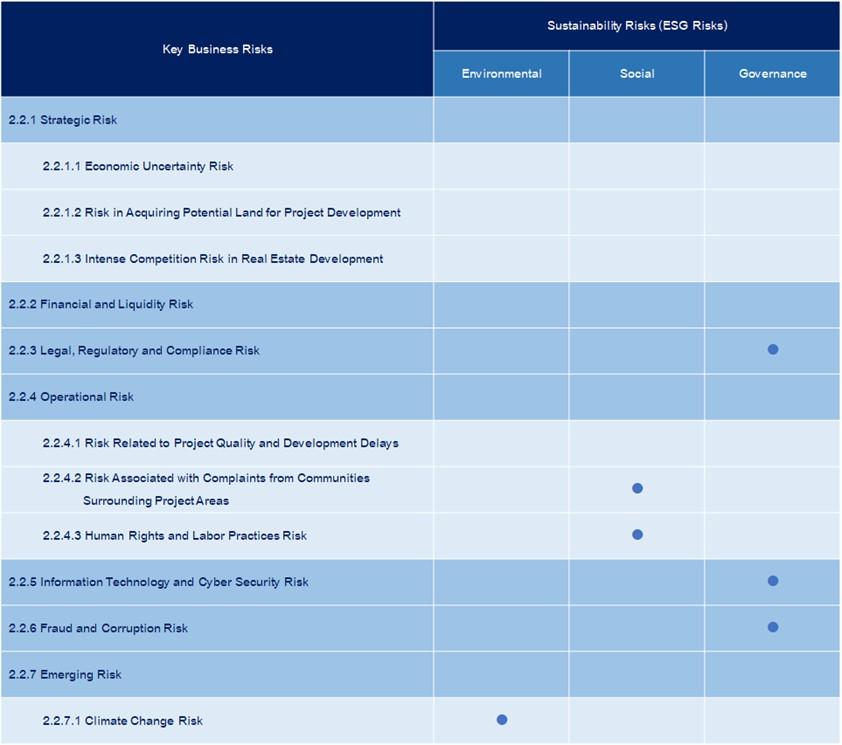
Risks to the Company's Business Operations
Risk Register
| Risk Name | Risk Characteristics | Consequences | Management Measures | Related Risk Factors |
|---|---|---|---|---|
| Economic Uncertainty Risk | In 2025, both the domestic and global economic environments remain subject to a high degree of uncertainty. Concerns over the pace and sustainability of economic recovery have intensified, while purchasing power in both domestic and international markets has weakened. Ongoing global trade tensions, reciprocal tariff measures, economic polarization, and geopolitical conflicts have contributed to disruptions in global supply chains, as well as trade and investment activities worldwide. Thailand’s economic growth remains subdued amid rising cost-of-living pressures and increasing household debt levels. In addition, financial institutions have adopted more stringent credit approval criteria for both developers’ financing (pre-finance). | consumer mortgage lending (post-finance). These factors have collectively had a significant impact on purchasing power and consumer decision-making in the real estate market. | The Company closely monitors key indicators of the Thai and global economies, both at the macroeconomic level and in relation to the specific business segments in which it operates, as well as market trends, consumer behaviour, and competitive dynamics. The Company continuously adjusts its business plans to enhance flexibility and ensure timely responses to economic uncertainty. The Company remains focused on the development of urban residential projects and transit-oriented condominiums, which align with prevailing market demand. In addition, the Company has refined its marketing and sales strategies to effectively reach its target customer segments, including both domestic and international buyers. The Company has also developed residential projects targeting the high-net-worth segment in Bangkok and Phuket, as well as projects developed in collaboration with leading brands (Branded Residences), to create differentiation and cater to the lifestyle preferences of high-net-worth customers. The Company employs marketing and promotional strategies to stimulate sales, while emphasizing differentiated residential design that responds to the needs of its target customers. Sustainability considerations are integrated into project design under the concept of a “Sustainable Living Community”, which has become an important factor influencing purchasing decisions among the Company’s target customer segments. Furthermore, the Company places emphasis on effective cost and expense management measures to maintain operational efficiency and support the achievement of its targeted financial performance. | 728 · Description: Volatility in the industry in which the company operates · Info category: STRATEGIC_RISK · 738 · Description: Reliance on employees in key positions · Info category: OPERATIONAL_RISK · 756 · Description: Change in laws and regulations · Info category: COMPLIANCE_RISK · 761 · Description: Insufficient sources of funding · Info category: FINANCIAL_RISK · 762 · Description: Change in financial and investment policies of financial institutions that affect business operations · Info category: FINANCIAL_RISK · 729 · Description: Behavior or needs of customers / consumers · Info category: STRATEGIC_RISK · 739 · Description: Shortage or reliance on skilled workers · Info category: OPERATIONAL_RISK · 757 · Description: Laws and regulations is not favorable for doing business · Info category: COMPLIANCE_RISK · 730 · Description: Government policy · Info category: STRATEGIC_RISK · 740 · Description: Shortage or fluctuation in pricing of raw materials or productive resources · Info category: OPERATIONAL_RISK · 758 · Description: Violations of laws and regulations · Info category: COMPLIANCE_RISK · 764 · Description: Fluctuation in exchange rates, interest rates, or the inflation rate · Info category: FINANCIAL_RISK · 741 · Description: Systems or internal control system · Info category: OPERATIONAL_RISK · 759 · Description: Corporate Governance · Info category: COMPLIANCE_RISK · 732 · Description: Changes in technologies · Info category: STRATEGIC_RISK · 742 · Description: Human error in business operations · Info category: OPERATIONAL_RISK · 765 · Description: Fluctuation in return on assets or investment · Info category: FINANCIAL_RISK · 1723 · Description: Legal risk · Info category: COMPLIANCE_RISK · 733 · Description: Business operations of partners in the supply chain · Info category: STRATEGIC_RISK · 743 · Description: Product obsolescence · Info category: OPERATIONAL_RISK · 744 · Description: Information security and cyber-attack · Info category: OPERATIONAL_RISK · 1724 · Description: Liquidity risk · Info category: FINANCIAL_RISK · 735 · Description: Reliance on large partners / distributors or few partners / distributors · Info category: STRATEGIC_RISK · 745 · Description: Loss or damage from non-compliance of partners or counterparties · Info category: OPERATIONAL_RISK · 1725 · Description: Income volatility · Info category: FINANCIAL_RISK · 736 · Description: Damage to company image and reputation · Info category: STRATEGIC_RISK · 746 · Description: Delays in the development of future projects · Info category: OPERATIONAL_RISK · 1714 · Description: Competition risk · Info category: STRATEGIC_RISK · 1715 · Description: Economic risk · Info category: STRATEGIC_RISK · 749 · Description: Safety, occupational health, and working environment · Info category: OPERATIONAL_RISK · 1716 · Description: New business risk · Info category: STRATEGIC_RISK · 750 · Description: Climate change and disasters · Info category: OPERATIONAL_RISK · 751 · Description: Impact on the environment · Info category: OPERATIONAL_RISK · 1717 · Description: ESG risk · Info category: STRATEGIC_RISK · 1718 · Description: Pandemic risk · Info category: STRATEGIC_RISK · 1719 · Description: Climate change and disasters · Info category: STRATEGIC_RISK · 754 · Description: Corruption · Info category: OPERATIONAL_RISK · 1720 · Description: System disruption risk · Info category: OPERATIONAL_RISK · 1721 · Description: Inventory risk · Info category: OPERATIONAL_RISK · 1722 · Description: Pandemic risk · Info category: OPERATIONAL_RISK |
| Risk in Acquiring Potential Land for Project Development | As land is a key factor in the real estate development business, the Company places emphasis on the development of urban residential projects along mass transit lines, particularly in prime locations within Bangkok and its metropolitan areas. These locations are highly sought after by property developers, resulting in intense competition for land acquisition among market participants. In addition, the Company’s policy of not holding undeveloped land prior to project investment may expose the Company to risks associated with the sourcing and acquisition of land that may not be fully aligned with its business plans, or to the acquisition of land at relatively high prices. | Such factors may have an adverse impact on the Company’s business plans and project development costs and could potentially limit the Company’s ability to develop projects that generate returns in accordance with its investment policy. | The Company undertakes advance investment planning and establishes land acquisition plans that are aligned with its business plans and liquidity position. The feasibility of each project investment is carefully evaluated prior to development. In addition, the Company has implemented a rigorous and transparent decision-making process for land acquisition, which takes into consideration market data, competitive landscape, land prices in comparison with official government appraisals, and valuations conducted by independent appraisers. Such information is used as a framework for assessing appropriate locations and price levels in collaboration with the Company’s partner brokers. These measures enable the Company to mitigate risks associated with the inability to source and acquire land in locations and at prices that are consistent with its business plans. Furthermore, the land sourcing and acquisition process is conducted through a committee-based structure comprising senior executives with expertise in land acquisition and business development, finance, as well as legal and regulatory matters. This governance structure is designed to ensure that the Company can acquire land in appropriate locations and at reasonable prices, thereby supporting the Company’s ability to generate revenue in accordance with its established business plans. | 728 · Description: Volatility in the industry in which the company operates · Info category: STRATEGIC_RISK · 729 · Description: Behavior or needs of customers / consumers · Info category: STRATEGIC_RISK · 733 · Description: Business operations of partners in the supply chain · Info category: STRATEGIC_RISK · 746 · Description: Delays in the development of future projects · Info category: OPERATIONAL_RISK · 1715 · Description: Economic risk · Info category: STRATEGIC_RISK · 1716 · Description: New business risk · Info category: STRATEGIC_RISK · 1719 · Description: Climate change and disasters · Info category: STRATEGIC_RISK |
| Intense Competition Risk in Real Estate Development | The real estate development business is characterized by intense competition, including competition among existing developers, new entrants seeking to invest in the industry, companies listed on the Stock Exchange of Thailand, as well as smaller-scale operators. In addition, the level of unsold inventory in the market has increased significantly as a result of the slowdown in both domestic and global economic conditions, elevated household debt levels, constraints on consumers’ debt-servicing capacity, a significant decline in purchasing power, and the more stringent mortgage approval criteria adopted by financial institutions. Furthermore, aggressive marketing and sales strategies employed by developers to accelerate inventory clearance and boost sales have intensified price competition and led to heightened price wars within the market. These factors may pose risks that could adversely affect the Company’s operating performance and long-term business. | The situation impacts the real estate development business in various aspects, including a decline in profits due to price wars and increased marketing costs, cash flow constraints caused by rising inventory levels and slowing sales, as well as reduced sales resulting from weakened consumer purchasing power and stricter loan approvals by financial institutions. Additionally, it increases investment risks, potentially leading to delays in new project developments, and affects investor and shareholder confidence if business performance fails to meet the expected targets. | The Company closely analyses domestic and global economic conditions, as well as market demand and supply dynamics. In addition, the Company continuously monitors consumer behaviour, market trends, and various factors that may have both positive and negative impacts on its business in order to formulate appropriate strategies and regularly review and adjust its project development plans in line with prevailing market conditions. The Company adopts proactive marketing and sales strategies, effective cost management practices, and a range of promotional activities, while expanding new sales channels both domestically and internationally. The Company focuses on the development of transit-oriented condominiums and fully furnished residential projects that meet the needs of urban customers. Emphasis is also placed on project development quality and after-sales services, supported by clearly defined customer satisfaction indicators that are used to continuously enhance service quality and strengthen customer satisfaction. Furthermore, the Company utilizes data analytics as a key tool to analyse, monitor, and manage sales performance in line with established targets. This enables the Company to effectively manage inventory levels and respond promptly to changes in market conditions. | 728 · Description: Volatility in the industry in which the company operates · Info category: STRATEGIC_RISK · 729 · Description: Behavior or needs of customers / consumers · Info category: STRATEGIC_RISK · 730 · Description: Government policy · Info category: STRATEGIC_RISK · 731 · Description: Policies or international agreements related to business operations · Info category: STRATEGIC_RISK · 732 · Description: Changes in technologies · Info category: STRATEGIC_RISK · 733 · Description: Business operations of partners in the supply chain · Info category: STRATEGIC_RISK · 734 · Description: Reliance on large customers or few customers · Info category: STRATEGIC_RISK · 735 · Description: Reliance on large partners / distributors or few partners / distributors · Info category: STRATEGIC_RISK · 736 · Description: Damage to company image and reputation · Info category: STRATEGIC_RISK · 1714 · Description: Competition risk · Info category: STRATEGIC_RISK · 1715 · Description: Economic risk · Info category: STRATEGIC_RISK · 1716 · Description: New business risk · Info category: STRATEGIC_RISK · 1741 · Description: Corporate ownership structure risk · Info category: STRATEGIC_RISK · 1717 · Description: ESG risk · Info category: STRATEGIC_RISK · 1719 · Description: Climate change and disasters · Info category: STRATEGIC_RISK |
| Financial and Liquidity Risk | In 2025, both the global and domestic economic environments experienced significant volatility and a marked slowdown. Purchasing power among both international and domestic customers declined, while household debt levels continued to rise. In addition, financial institutions adopted highly stringent lending criteria for both developers’ financing and residential mortgage loans. As a result, both Thai and foreign consumers deferred their decisions to purchase residential properties. These factors have had a direct impact on the real estate development business, which is inherently capital-intensive and requires continuous investment. The slowdown in sales has resulted in performance falling below targets, thereby exposing the Company to heightened financial and liquidity risks due to delays in converting invested capital into revenue as planned. | Consequently, these conditions have directly affected the Company’s revenue, cost structure, and net profit. | The Company has established a cash flow and liquidity management plan that is aligned with its objectives and strategic goals, and closely and prudently monitors its liquidity position on an ongoing basis. The Company diversifies its funding sources to ensure sufficient and appropriate financing for project development and business operations. In addition, the Company has implemented budget management measures, reduced operating expenses, and enhanced the management of project costs and financial expenses, while strengthening financial planning discipline to improve overall efficiency. The Company also maintains its interest-bearing debt to equity ratio within an appropriate level, in compliance with financial institutions’ requirements and within the covenants stipulated under its debenture agreements. At the same time, the Company has adopted strategies to accelerate sales and transfers of ownership for ready-to-transfer projects and newly completed projects in 2025. In 2025, the Company was able to effectively manage liquidity risk and secure sufficient funding to support its operations in accordance with its plans. The Company fully complied with all loan conditions and financial covenants and was able to meet all debenture repayment obligations as scheduled. The Company adjusted its sales and transfer strategies through targeted marketing and promotional activities, offering fully furnished residential units, and setting prices that align with the needs of its target customers. The Company also expanded the range of projects offered to customers, while facilitating coordination with financial institutions to support mortgage loan applications and closely monitor approval processes. Furthermore, the Company developed residential projects targeting high-net-worth customers in Bangkok and Phuket to create differentiation and cater to the lifestyle preferences of the high-net-worth segment. | 758 · Description: Violations of laws and regulations · Info category: COMPLIANCE_RISK · 736 · Description: Damage to company image and reputation · Info category: STRATEGIC_RISK · 749 · Description: Safety, occupational health, and working environment · Info category: OPERATIONAL_RISK · 751 · Description: Impact on the environment · Info category: OPERATIONAL_RISK |
| Legal, Regulatory and Compliance Risk | The real estate development business is subject to supervision by multiple government authorities and must comply with numerous applicable laws, regulations, and related requirements, which are complex and subject to frequent changes. These include, among others, the Town Planning Act, the Land Allocation Act, the Land and Building Tax Act, the Condominium Act, the Building Control Act, and the Personal Data Protection Act. In addition, as a company listed on the Stock Exchange of Thailand, the Company is required to comply with the rules and regulations of the Stock Exchange of Thailand and the Securities and Exchange Commission. The diversity of applicable laws, the complexity of their respective requirements, as well as potential future regulatory changes, give rise to legal, regulatory, and compliance risks. Accordingly, the Company must exercise due care and diligence in its operations to ensure compliance with all relevant laws, regulations, and requirements. | Any failure or incomplete compliance may result in legal disputes, regulatory liabilities, community complaints, and adverse impacts on project development costs, project timelines, operational plans, and the Company’s reputation. | The Company places emphasis on compliance with all applicable laws, regulations, and related requirements. The Company regularly and prudently reviews relevant legal and regulatory criteria and requirements and has established dedicated working groups to assess and interpret laws and regulations applicable to its business operations. The Company closely monitors and evaluates changes in laws and regulations that may affect its business, and communicates relevant legal, regulatory, and compliance requirements to the relevant employees to ensure that the Company’s operations are conducted in compliance with applicable laws and regulations. These measures support effective compliance management and help mitigate risks and potential adverse impacts on the Company. | 756 · Description: Change in laws and regulations · Info category: COMPLIANCE_RISK · 757 · Description: Laws and regulations is not favorable for doing business · Info category: COMPLIANCE_RISK · 758 · Description: Violations of laws and regulations · Info category: COMPLIANCE_RISK · 759 · Description: Corporate Governance · Info category: COMPLIANCE_RISK · 1723 · Description: Legal risk · Info category: COMPLIANCE_RISK |
| Risk Related to Project Quality and Development Delay | Real estate project development is exposed to risks relating to project quality and development delays arising from various factors, including contractors’ lack of sufficient expertise, experience, or construction standards; shortages of skilled or qualified labour; contractors’ financial constraints; delays in contractors’ work performance; disputes with communities surrounding project sites; as well as force majeure events and natural disasters beyond the Company’s control. These factors may adversely affect both the quality and timeliness of project development. | Such risks may result in customer reservation cancellations, sales revenue falling short of targets, potential legal claims against the Company, and damage to the Company’s reputation. | The Company emphases construction quality and standards. In appointing contractors, the Company considers factors including experience, standards and quality of workmanship, financial capability, track record and accountability, construction processes and technologies, as well as the contractor’s reputation. The Company has established clear policies and procedures for contractor selection to ensure that the selection process is conducted in a prudent, rigorous, transparent, and efficient manner, enabling the Company to engage qualified and reputable contractors with proven experience in project development. In addition, the Company closely monitors and inspects contractors’ performance throughout the entire project development period and regularly reports monitoring results to the committees responsible for the management and oversight of the Company’s project development. The Company has also established a community relations function that works in coordination with relevant construction units and environmental impact monitoring teams from the project preparation stage. This function proactively engages with surrounding communities through site visits, ongoing situation monitoring, issue resolution, and regular reporting to management. Furthermore, the Company closely monitors environmental impacts for each project and implements preventive and mitigating measures to address potential risks arising from community complaints that may affect project development. These measures are intended to ensure that construction is completed with the required quality and within the planned timeframe, and that the Company’s project management is conducted efficiently and in accordance with its established objectives. | 738 · Description: Reliance on employees in key positions · Info category: OPERATIONAL_RISK · 739 · Description: Shortage or reliance on skilled workers · Info category: OPERATIONAL_RISK · 741 · Description: Systems or internal control system · Info category: OPERATIONAL_RISK · 742 · Description: Human error in business operations · Info category: OPERATIONAL_RISK · 746 · Description: Delays in the development of future projects · Info category: OPERATIONAL_RISK · 749 · Description: Safety, occupational health, and working environment · Info category: OPERATIONAL_RISK · 750 · Description: Climate change and disasters · Info category: OPERATIONAL_RISK · 751 · Description: Impact on the environment · Info category: OPERATIONAL_RISK · 752 · Description: Impact from population structure · Info category: OPERATIONAL_RISK · 753 · Description: Impact on human rights · Info category: OPERATIONAL_RISK |
| Risk Associated with Complaints from Communities Surrounding Project Areas | Real estate development projects, particularly large-scale residential condominium projects, have direct impacts on the environment and surrounding communities. If appropriate management processes and strict compliance with environmental impact mitigation measures are not adequately implemented, such projects may face opposition from local communities or complaints lodged with relevant authorities. These issues may escalate to court orders requiring emergency suspension of construction or legal proceedings against the Company. Such circumstances may result in delays in project execution and increased costs associated with remediation and dispute resolution, which could adversely affect the Company’s business plans and operations. In addition, the Company may be subject to legal penalties or fines that could impact its financial position, as well as reputational damage that may adversely affect its corporate image, credibility, and stakeholder confidence. | It impacts the company's financial status, the environment, as well as the company's image, reputation, and credibility in the long term. | The Company emphasizes compliance with environmental laws and standards by conducting Environmental Impact Assessments (EIA) and implementing robust environmental impact mitigation measures. The Company has established dust control measures at construction sites, including the design of enclosed tile-cutting rooms to confine high dust-generating activities and facilitate effective dust collection and management. The Company has established a community relations function that works in coordination with relevant construction units and environmental impact monitoring teams from the project preparation stage. This function proactively engages with surrounding communities through site visits, continuous situation monitoring, and community outreach, as well as the identification and implementation of appropriate remedial measures. The outcomes of such activities are regularly monitored and reported to management. In addition, the Company closely monitors the environmental impacts of each project to determine preventive and mitigating measures in the event of risks arising from community complaints that may affect project development. | 1723 · Description: Legal risk · Info category: COMPLIANCE_RISK · 749 · Description: Safety, occupational health, and working environment · Info category: OPERATIONAL_RISK · 751 · Description: Impact on the environment · Info category: OPERATIONAL_RISK · 752 · Description: Impact from population structure · Info category: OPERATIONAL_RISK · 753 · Description: Impact on human rights · Info category: OPERATIONAL_RISK |
| Human Rights and Labor Practices Risk | Real estate development requires a substantial workforce. The Company recognizes the risks related to human rights and labor management involving both its employees and the workforce engaged in real estate project development. Human rights and labor management risks may adversely affect the Company’s operations, potentially causing construction disruptions and legal claims, and may result in litigation liabilities that could impact on the Company’s financial position, reputation, and credibility. | This may result in disruptions to construction, lawsuits related to human rights or labor issues, and subsequent legal burdens, all of which could impact the company's operations, causing damage to its financial status, reputation, and credibility in the long term, as well as eroding trust among stakeholders both within and outside the organization. | The Company has established policies on employee conduct and responsibilities under its Code of Conduct and Business Ethics. The Company treats its employees in accordance with human rights principles, with respect for human dignity, honor, and personal rights. The Company ensures a safe working environment for the life and property of employees and provides necessary equipment to support their work. Annual health check-ups and medical welfare benefits are provided to employees. In addition, the Company organizes training programs to enhance employees’ knowledge, skills, and capabilities in various areas. The Company has implemented a fair performance evaluation system and regularly reviews employee remuneration in line with individual performance, the Company’s operating results, market conditions, and business competition. With respect to business partners and contractors, the Company has established selection criteria requiring compliance with the Company’s Code of Conduct and Business Ethics. The Company considers contractors who are certified in occupational safety, health, and working environment standards. The Company also stipulates in its contracts that contractors must comply with the Company’s Code of Conduct and Business Ethics and must employ legally authorized workers in accordance with applicable laws. The Company has established whistleblowing and complaint channels for its employees and external parties. The Company has defined procedures for fact-finding and investigation based on available evidence in a fair and transparent manner. In 2025, the Company did not receive any complaints or face any legal claims related to human rights violations. | 738 · Description: Reliance on employees in key positions · Info category: OPERATIONAL_RISK · 739 · Description: Shortage or reliance on skilled workers · Info category: OPERATIONAL_RISK · 741 · Description: Systems or internal control system · Info category: OPERATIONAL_RISK · 742 · Description: Human error in business operations · Info category: OPERATIONAL_RISK · 749 · Description: Safety, occupational health, and working environment · Info category: OPERATIONAL_RISK · 753 · Description: Impact on human rights · Info category: OPERATIONAL_RISK |
| Information Technology and Cyber Security Risk | Information technology is a critical tool in business operations, particularly in the transition toward a digital society, where data has become one of the key factors in modern business operations. The Company utilizes information technology across its operations and core business processes, including economic, business, market, competition, consumer, and customer analysis; the formulation of business strategies and plans; product and service improvement and development; design; marketing and sales; inspection and acceptance of work; delivery of products and services; customer relationship management; and internal support systems. The use of information technology enhances operational efficiency and strengthens the Company’s competitive capabilities. However, the extensive use of information technology may expose the Company to risks related to information technology systems and cybersecurity, including the risk of leakage of critical information. | Such incidents could disrupt business operations and cause damage to the Company’s operations, corporate image, reputation, and credibility. | The Company recognizes the risks and potential impacts arising from information technology and cybersecurity risks and acknowledges the importance of effective management of such risks. The Company has established information technology policies in accordance with international standards, covering data, operating systems, application systems, databases, computer equipment, and communication networks. These policies include the implementation of preventive security systems, regular backup of critical data, and continuous monitoring of developments and potential threats in order to prevent or mitigate potential damage to the Company. In addition, the Company provides training programs to enhance awareness of information technology security, ensuring that employees are able to use information technology appropriately, effectively, and securely, and are protected against various cyber threats. The Company has also established an Information Technology Disaster Recovery Plan, which defines system recovery procedures within specified timeframes. The Company conducts regular annual disaster recovery drills to ensure preparedness and timely response to potential incidents, thereby minimizing the impact of any damage to information technology systems and the Company’s business operations. | 732 · Description: Changes in technologies · Info category: STRATEGIC_RISK · 744 · Description: Information security and cyber-attack · Info category: OPERATIONAL_RISK · 1720 · Description: System disruption risk · Info category: OPERATIONAL_RISK |
| Fraud and Corruption Risk | As a real estate development company undertaking large-scale projects that require significant capital investment and involve interactions with multiple public and private sector entities, the Company is exposed to risks related to fraud and corruption. Such risks may result in legal liabilities and litigation, as well as cause damage to the Company’s reputation, corporate image, and credibility. | This could result in the company facing complex and prolonged legal burdens, which not only cause damage to the company's financial status but also severely impact its reputation, image, and credibility in the eyes of stakeholders both within and outside the organization, as well as potentially diminishing trust from investors and business partners in the long term. | The Company emphasizes on anti-corruption and conducting business with transparency in accordance with good governance principles and good corporate governance practices. The Company has established a Code of Conduct and Business Ethics, an Anti-Corruption Policy, and a Whistleblowing Policy, including channels and procedures for whistleblower protection and fair complaint handling. The Company assesses the likelihood and potential impacts of corruption risks within its business processes and has implemented an internal control system appropriate to the level of risk. In addition, the Company has established criteria for the selection of business partners and contractors who comply with the Company’s Code of Conduct and Business Ethics and has entered into anti-bribery cooperation agreements with its business partners. Furthermore, the Company stipulates in its contracts that contractors must strictly comply with the Company’s Code of Conduct and Business Ethics, as well as its anti-bribery and anti-corruption requirements. | 741 · Description: Systems or internal control system · Info category: OPERATIONAL_RISK · 742 · Description: Human error in business operations · Info category: OPERATIONAL_RISK · 745 · Description: Loss or damage from non-compliance of partners or counterparties · Info category: OPERATIONAL_RISK · 754 · Description: Corruption · Info category: OPERATIONAL_RISK |
| Climate Change Risk | Global warming has intensified, leading to increasingly severe climate change impacts such as extreme natural disasters, flooding, earthquakes, and droughts. Climate change represents a significant risk to the Company in both the short and long term, as its impacts are becoming more evident and increasingly severe over time. The Company recognizes climate change as a material risk, as it may adversely affect the Company’s strategic and operational risks. | Such impacts may include effects on the overall economic conditions, customers’ purchasing power, damage to the Company’s projects, delays or disruptions in construction activities, and potential impacts on sales performance. | The Company minimizes environmental impacts and fosters a sustainable and livable society over the long term. The Company places emphasis on compliance with environmental laws and standards through the conduct of Environmental Impact Assessments (EIA) and the implementation of comprehensive environmental mitigation measures. During the construction phase, the Company conducts regular inspections to ensure compliance with environmental mitigation measures and reports the inspection results to management on a regular basis. The Company has established a community relations function that works closely with relevant departments involved in the construction process to proactively engage with communities surrounding the project sites, monitor construction-related impacts, and promptly identify and implement appropriate corrective actions. Progress and outcomes are continuously monitored and regularly reported to management. The Company designs its projects with sustainability in mind under the concept of a Sustainable Living Community, with a strong commitment to reducing environmental impacts and creating an environmentally friendly and livable society over the long term. The Company selects construction materials that promote energy efficiency and minimize environmental impacts. For CULTURE project, the Company has implemented dust reduction measures at construction sites by designing dedicated tile-cutting rooms to confine high dust-generating activities and facilitate effective dust collection. During piling work, water spraying is applied on steel plates to clean construction sites and reduce dust dispersion. The Company uses eco-friendly innovative paints for both interior and exterior applications, which have been certified under the Carbon Footprint Calculation by the Thailand Greenhouse Gas Management Organization. In addition, the Company selects air-purifying plants with the capability to capture and reduce dust particles and pollutants for landscaping within its projects. The Company collaborates with business partners to upcycle excess fabric from production processes into employee uniforms. Furthermore, the Company uses recycled fabric for property transfer packaging, enabling customers to recycle and repurpose the packaging into environmentally friendly designer bags. This initiative aims to create added value for packaging materials by promoting reuse and encouraging sustainable consumption through everyday use. | 750 · Description: Climate change and disasters · Info category: OPERATIONAL_RISK · 751 · Description: Impact on the environment · Info category: OPERATIONAL_RISK · 1718 · Description: Pandemic risk · Info category: STRATEGIC_RISK · 1719 · Description: Climate change and disasters · Info category: STRATEGIC_RISK · 1722 · Description: Pandemic risk · Info category: OPERATIONAL_RISK |